Save as PDF
Opens your browser print dialog — select "Save as PDF" to download.
Second Semester
Computer Science and Engineering/Information
Technology
Scheme OCBC 2019
BASICS OF ELECTRICAL, ELECTRONICS AND
MEASUREMENT
Time : Three Hours
Maximum Marks : 70
Note : i) All 7 Questions are Compulsory. Internal choices has been given in each LO (Learning Outcome).
सभी 7 प्रश्न अनिवार्य हैं। आंतरिक विकल्प प्रत्येक LO (लर्निंग आउटकम) में दिए गए हैं।
ii) In case of any doubt or dispute, the English version question should be treated as final.
किसी भी प्रकार के संदेह अथवा विवाद की स्थिति में अंग्रेजी भाषा के प्रश्न को अंतिम माना जायेगा।
| Q. | LO | Questions | Marks |
|---|---|---|---|
| 1. | LO1 & LO2 |
a)
Define conductivity and temperature coefficient of resistance. चालकता एवं प्रतिरोध का ताप गुणांक परिभाषित करें।
b)
What do you mean by electrical power and electrical energy? What are their units? विद्युत शक्ति एवं विद्युत ऊर्जा से आप क्या समझते है? उनकी इकाईयाँ क्या हैं?
c)
By what factor resistance will change, if current through a resistor is doubled, while rest of the conditions remains same? अगर एक प्रतिरोध में बहने वाली धारा को मान दोगुना हो जाता है तो प्रतिरोध के मान में परिवर्तन कितना होगा? जबकि शेष स्थिति समान रहती है। OR/अथवा |
3 4 3 |
| [2] | |||
| 2. | LO4 & LO5 |
a)
State Kirchhoff's voltage law. Calculate the value of current I in the circuit given below: किरचॉफ वोल्टेता नियम प्रतिपादित करें। नीचे दिये गये परिपथ में धारा I के मान की गणना करें। 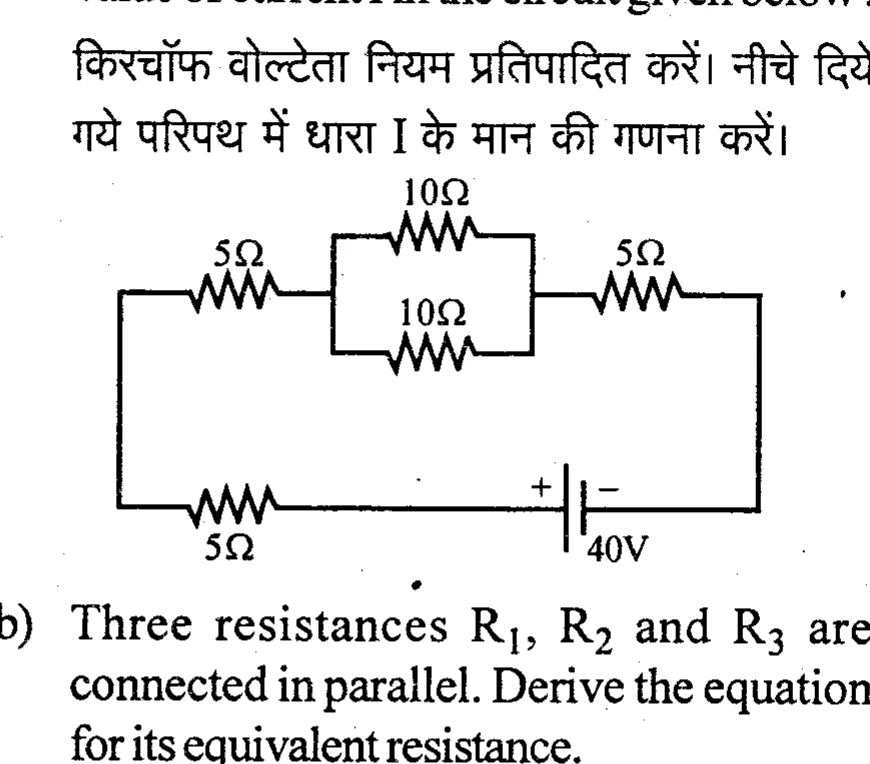
b)
Three resistances R1, R2 and R3 are connected in parallel. Derive the equation for its equivalent resistance. R1, R2 एवं R3 मान के तीन प्रतिरोध समानांतर क्रम में संयोजित है तो उसके समतुल्य प्रतिरोध का समीकरण व्युत्पन्न करें। OR/अथवा
a)
If an alternating current is represented by i = 120 sin 314t. Findout:
अगर एक प्रत्यावर्ती धारा को i = 120 sin 314t द्वारा प्रदर्शित किया जाता है तो ज्ञात करें।
|
6 4 4 |
| [3] | |||
| 3. | LO7 |
b)
Describe the series RLC circuit with Phasor diagram in an AC circuit. एक प्रत्यावर्ती धारा परिपथ के RLC परिपथ को कला आरेख सहित समझाइये। OR/अथवा
a)
Compare a magnetic circuit and an electric circuit. एक चुम्बकीय परिपथ एवं एक विद्युत परिपथ की तुलना करें।
b)
State Faraday's law of electromagnetic induction. फैराडे के विद्युत चुम्बकीय प्रेरण के नियम प्रतिपादित करें।
a)
What do you mean by Doping? Explain p-type semiconductors. डोपिंग से आप क्या समझते है? p-प्रकार अर्धचालक समझाइये।
b)
Differentiate between intrinsic and extrinsic semiconductors. शुद्ध एवं अशुद्ध अर्धचालकों में अंतर बताइये।
c)
Draw and explain energy band diagram of conductors, semiconductors and insulators. चालक, अर्धचालक एवं कुचालक के लिये ऊर्जा बैण्ड आरेख बनाकर समझाइये। OR/अथवा
a)
Explain Diffusion and Drift in semiconductors. अर्धचालकों में डिफ्यूजन एवं ड्रिफ्ट को स��झाइये।
b)
Differentiate between Zener and Avalanche breakdown. जेनर एवं अवलांच ब्रेकडाउन में अंतर बताइये। |
6 5 5 3 3 4 2 4 |
| [4] | |||
| 4. | LO8 |
a)
Why rectifier is required? Classify them. दिष्टकारी की आवश्यकता क्यों है? इन्हें वर्गीकृत करें।
b)
Explain a half wave rectifier with the help of input and output waveforms. निवेश एवं निर्गत तरंगों की सहायता से एक अर्ध-तरंग दिष्टकारी को समझाइये। OR/अथवा
a)
Obtain the expression for average, peak and R.M.S. value of current in bridge rectifier. सेतु दिष्टकारी के लिये औसत, शिखर एवं वर्ग माध्य मूल मान के लिये व्यंजक प्राप्त करें।
b)
Compare half wave, centre-tapped and bridge rectifiers. अर्धतरंग, केन्द्र-टैपित एवं सेतु दिष्टकारी में तुलना करें। |
4 6 6 4 |
| 5. | LO10 |
a)
Obtain the relation between parameters 'α' and 'β' of a semiconductor transistor. एक अर्धचालक ट्रांजिस्टर के प्राचलों 'α' एवं 'β' में संबंध निकालें।
b)
Compare FET and BJT. FET एवं BJT में तुलना करें। OR/अथवा |
5 5 |
| [5] | |||
|
a)
Compare CB, CE and CC transistor configurations and write their applications. CB, CE एवं CC ट्रांजिस्टर विन्यासों की तुलना करें एवं उनके अनुप्रयोग लिखें।
b)
Draw symbol of UJT, FET and SCR and write their applications. UJT, FET तथा SCR के चिन्ह बनाइये एवं इसके उपयोग कीजिये। |
5 5 |
||
| 6. | LO11 |
a)
Explain the block diagram of regulated power supply. विनियमित शक्ति प्रदायी के खण्ड चित्र को समझाइये।
b)
Why we need voltage regulators? Define voltage regulation factor. वोल्टेता नियामक की हमें क्यों आवश्यकता है? वोल्टेता विनियमन परिभाषित करें। OR/अथवा
a)
Describe the working of S.M.P.S. and give its advantages. S.M.P.S. की कार्यविधि का वर्णन करें एवं उसके लाभ बताइये।
b)
Specify output voltage of regulator ICs IC79XX. विनियमित IC IC79XX के निर्गत वोल्टेज को विनिर्दिष्ट कीजिये। |
5 5 5 5 |
| 7. | LO13 & LO14 |
a)
List out various types of errors and its causes, that occurred in a measurement system. एक मापन प्रणाली में होने वाली विभिन्न प्रकार की त्रुटियों को सूचीबद्ध करें एवं उनके कारक बताइये। |
5 |
| [6] | |||
|
b)
With the help of neat sketch of internal structure of CRT, explain function of each part. CRT की आंतरिक संरचना के स्वच्छ चित्र की सहायता से उसके प्रत्येक भाग के कार्य को समझाइये। OR/अथवा
a)
Write a short note on “Digital Multimeter”. अंकीय बहुमापी पर एक संक्षिप्त टिप्पणी लिखें।
b)
Explain the single phase static energy meter. एकल कला स्थिर ऊर्जामापी को समझाइये। |
5 5 5 |
||