Save as PDF
Opens your browser print dialog — select "Save as PDF" to download.
S/2025/6695
Total Pages : 3
Eighth Semester
PTDC Civil (Scheme July-2015)
STRUCTURAL DESIGN AND DRAFTING
Time : Three Hours
Maximum Marks : 100
Note : i)
Attempt total five questions out of eight.
कुल आठ में से पाँच प्रश्नों को हल कीजिए।
ii)
Use IS code 456-2000 and IS 800-1984.
IS कोड 456-2000 एवं IS 800-1984 का उपयोग करें।
iii)
In case of any doubt or dispute the English version should be treated as final.
किसी भी प्रकार के संदेह या विवाद की स्थिति में अंग्रेजी भाषा के प्रश्न को अंतिम माना जायेगा।
1. a)
Differentiate between under reinforced, over reinforced and balanced sections with the help of sketch. (8)
न्यूत प्रतिबल, अति प्रतिबल एवं संतुलित प्रतिबल काटों को चित्र की सहायता से अंतर स्पष्ट कीजिए।
b)
Find the moment of resistance (M.R.) of a beam if b = 250 mm, d = 500 mm, d' = 50 mm, Asc = 240 mm², Ast = 960 mm². Grade of concrete is M20 and steel Fe-415. (12)
एक धरन का प्रतिरोध आघूर्ण (M.R.) ज्ञात कीजिए, यदि b = 250 मिमी, d = 500 मिमी, d' = 50 मिमी, Asc = 240 मिमी², Ast = 960 मिमी² हो। कंक्रीट M20 व स्टील Fe-415 है।
2. a)
Describe the assumptions of working stress method. (8)
कार्यकारी प्रतिबल विधि की मान्यताओं का वर्णन कीजिए।
b)
A R.C.C. beam of rectangular section 200 mm × 550 mm deep is reinforced with 4 bars of 25mm diameter at an effective depth of 500 mm. Using M20 grade of concrete and Fe415 steel. Calculate the moment of resistance of the section. (L.S.M.). (12)
एक आयताकार 200 मिमी × 550 मिमी गहराई के आर.सी.सी. सेक्शन में 25 मिमी व्यास की 4 छड़ें 500 मिमी प्रभावी गहराई पर रखी है। M20 ग्रेड कंक्रीट तथा Fe415 स्टील के उपयोग के साथ प्रतिबल बंकन आघूर्ण ज्ञात कीजिए।
[2]
3. a)
Design a column using LSM having an axial load of 2400 KN and unsupported length of 3.5m. Use M20 concrete and Fe415 steel. (15)
एक स्तंभ का सीमा स्थिति विधि का अभिकल्पन कीजिए जिस पर 2400 कि.न्यू. का अक्षीय भार लग रहा है। और अतिरोधक लम्बाई 3.5 मी. है। कंक्रीट M20 एवं Fe415 इस्पात का प्रयोग किया गया है।
b)
Differentiate between short column and long column. (5)
लघु स्तंभ एवं दीर्घ स्तंभ में अंतर स्पष्ट कीजिए।
4. a)
Explain the procedure for design of footing for a column. (8)
स्तंभ की फुटिंग के अभिकल्पन की विधि समझाइए।
b)
A R.C.C. short column 400 mm × 400 mm is reinforced with 4 bars of 16 mm ø and 4 bars of 20 mm ø main reinforcement. Calculate the service load that column can take. (L.S.M.). (12)
एक आर.सी.सी. लघु स्तंभ 400 मिमी × 400 मिमी को 16 मिमी व्यास के 4 तथा 20 मिमी व्यास के 4 में मुख्य सरिये लगाए जाते हैं। स्तंभ के लिए वहन किया जाने वाला सर्विस भार ज्ञात कीजिए।
5. a)
Explain the types of welded joints. (8)
वेल्डेड जॉइण्ट के प्रकारों को समझाइए।
b)
Explain rivet value for double cover riveted butt joint. The thickness of main plates and cover plates are 20mm and 8mm respectively. The diameter of rivet is 20mm. Take permissible shear stress as 100 N/mm² and permissible bearing stress as 300 N/mm². (12)
दो आवरण प्लेटों वाले ढक्कर मोड़ के लिए रिवेट मान ज्ञात कीजिए। मुख्य प्लेट तथा आवरण प्लेटों की खुलाई क्रमश: 20 मिमी तथा 8 मिमी है। रिवेट का व्यास 20 मिमी है। अनुज्ञेय अपरूपण प्रतिबल 100 N/mm² है तथा अनुज्ञेय धारण प्रतिबल 300 N/mm² लीजिए।
6. a)
Write and explain design steps for tension members. (8)
तनन अवयव के अभिकल्पन की स्टेप्स लिखिए एवं समझाइए।
[3]
b)
A timber column 20 cm × 20 cm with 2 m unsupported length is of Sal wood. Calculate load carrying capacity. Safe compressive stress for sal wood is 10.6 N/mm². (12)
2 मीटर लम्बाई के टिंबर स्तंभ का काट 20 सेमी × 20 सेमी का है। साल टिंबर के स्तंभ की भार वहन क्षमता ज्ञात कीजिए। साल टिंबर के लिए अनुज्ञेय संपीड़न प्रतिबल का मान 10.6 N/mm² है।
7. a)
Explain loads of roof truss. (8)
छत कैंची पर कार्यरत भारों को समझाइए।
b)
Write short notes on (any four): (12)
- Characteristics strength
- Modular ratio
- Slenderness ratio
- Lacing and battening
- R.C.C.
निम्नलिखित पर संक्षिप्त टिप्पणी लिखिए। (कोई चार)
- विशिष्ठ सामर्थ्य
- मॉड्यूलर अनुपात
- तनुता अनुपात
- जालक एवं पट्टी
- आर.सी.सी.
8.
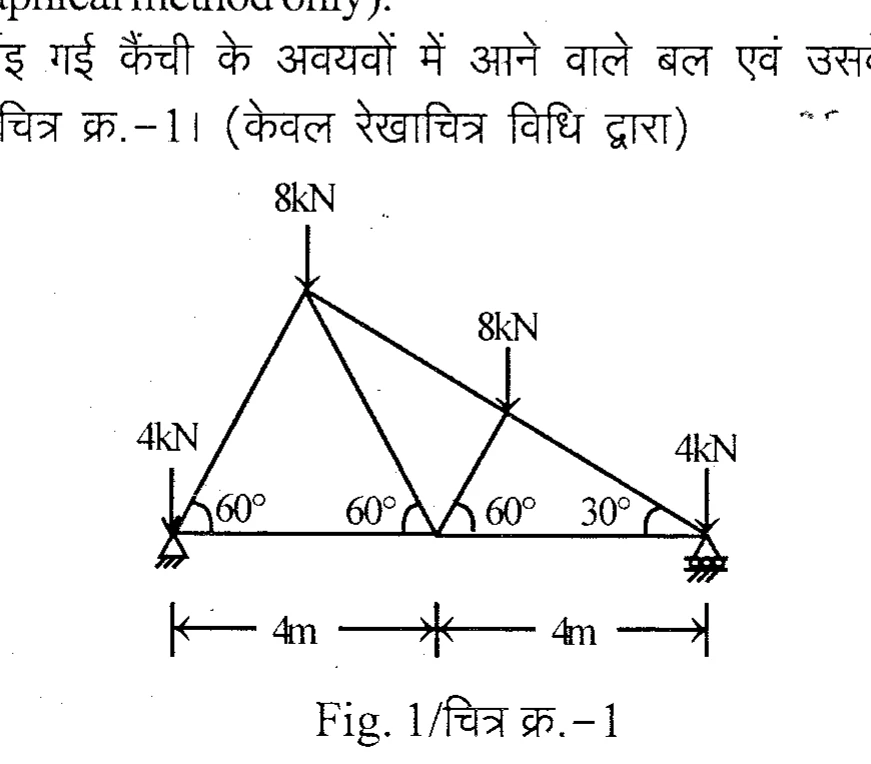
Find the force and their nature in members of truss given below fig. 1. (Use graphical method only). (20)
नीचे दर्शाई गई कैंची के अवयवों में आने वाले बल एवं उसके स्वभाव ज्ञात कीजिए। चित्र क्र.–1। (केवल रेखाचित्र विधि द्वारा)