Save as PDF
Opens your browser print dialog — select "Save as PDF" to download.
ME-701 (GS)
B.Tech., VII Semester
Examination, June 2025
Grading System (GS)
Heat and Mass Transfer
Note: i) Attempt any five questions.
किसी पाँच प्रश्नों को हल कीजिए।
ii) All questions carry equal marks.
सभी प्रश्नों के समान अंक हैं।
iii) Assume suitable value for missing data, if any.
यदि कोई डाटा मिसिंग हो तो उपयुक्त वैल्यू मान लें।
iv) In case of any doubt or dispute the English version question should be treated as final.
किसी भी प्रकार के संदेह अथवा विवाद की स्थिति में अंग्रेजी भाषा के प्रश्न को अंतिम माना जाये
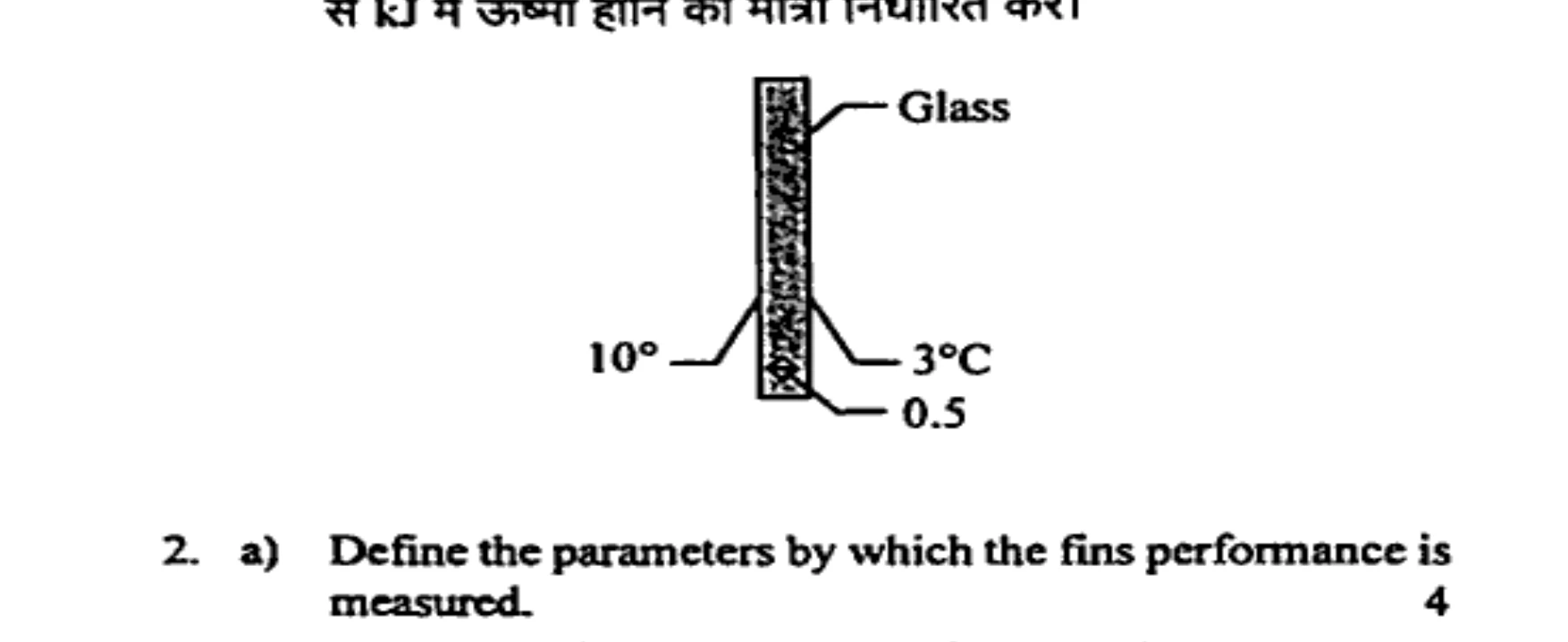
सर्दी में 0.5 सेमी. मोटी 2 × 2 मी2 खिड़की के शीशे की आंतरिक और बाहरी सतहें क्रमशः 10°C और 3°C हैं। यदि शीशे की ऊष्मीय चालकता 0.78 W/m. °C है, तो 5 घंटे की अवधि में शीशे के माध्यम से kJ में ऊष्मा हानि की मात्रा निर्धारित करें।
उन मापदंडों को परिभाषित करें जिनके द्वारा पंखों का प्रदर्शन मापा जाता है।
सतहों पर पंखों के व्यापक उपयोग का क्या कारण है?
ऊष्मा, आंतरिक ऊर्जा और तापीय ऊर्जा एक दूसरे से किस प्रकार संबंधित हैं?
ऊष्मा चालन संवहन से किस प्रकार भिन्न है?
एक स्टील की छड़ (k = 30 W/m-deg) जिसका व्यास 1 cm और लंबाई 5 cm है, एक दीवार से बाहर निकली हुई है जिसे 100°C पर रखा गया है। छड़ को उसके सिरे पर इंसुलेट किया गया है और h = 50 W/m²-deg और t_a = 30°C वाले वातावरण में रखा गया है। फिन की दक्षता और फिन की नोक पर तापमान की गणना करें।
एक घरेलू ओवन में 0.5 सेमी. मोटी क्रोम-निकेल (k = 19 W/mK) शीट द्वारा निर्मित एक मिश्रित दीवार है, जिसे 1 सेमी. मोटी एस्बेस्टस (k = 0.1105 W/mK) शीट द्वारा सहारा दिया गया है। स्थिर अवस्था में संचालन में ओवन के अंदर गर्म गैसें 350°C पर होती हैं जबकि वायुमंडलीय हवा 30°C पर होती है। ओवन की अंदर और बाहर की सतह पर संवहन ऊष्मा स्थानान्तरण गुणांक क्रमशः 100 W/m²K और 15 W/m²K हैं। ओवन की दीवार के माध्यम से प्रति इकाई क्षेत्र में ऊष्मा हानि की दर निर्धारित करें।
वाष्पीकरण और उबलने में क्या अंतर है?
फिल्म और ड्रॉपवाइज कंडेनसेशन के बीच क्या अंतर है? ऊष्मा स्थानांतरण का कौन-सा तंत्र अधिक प्रभावी है?
बलपूर्वक संवहन क्या है? बाह्य बलपूर्वक संवहन आंतरिक बलपूर्वक संवहन से किस प्रकार भिन्न है?
अशांत प्रवाह, लामिनार प्रवाह से किस प्रकार भिन्न है? किस प्रवाह के लिए ऊष्मा स्थानान्तरण गुणांक अधिक होता है?
रेल संख्या ग्राशॉफ संख्या से किस प्रकार भिन्न है?
रेडिएशन शील्ड क्या है? इसका उपयोग क्यों किया जाता है?
प्लांक के वितरण नियम को समझाइये।
एक ऐसे व्यक्ति पर विचार करें जिसका खुला सतही क्षेत्रफल 1.7 m2 है, उत्सर्जनता 0.85 है तथा सतही तापमान 30°C है। एक बड़े कमरे में विकिरण द्वारा उस व्यक्ति से ऊष्मा हानि की दर निर्धारित करें जिसकी दीवारें (i) 300 K तथा (ii) 280 K के तापमान पर हैं।
निर्माण प्रकार के अनुसार ताप विनिमयकों को वर्गीकृत करें और प्रत्येक प्रकार की विशेषताओं को समझाइए।
समान्तर प्रवाह हीट एक्सचेंनर्स के लिए LMTD समीकरण की स्थापना करें।
- Fin effectivenessफिन प्रभावशीलता
- Gray bodyग्रे बॉडी
- Fick's Lawफिंक का नियम
- LMTDLMTD
- Thermocoupleथर्मोकल
- Parallel flow heat exchangerसमानांतर प्रवाह हीट एक्सचेंजर