Save as PDF
Opens your browser print dialog — select "Save as PDF" to download.
ME-701 (GS)
B.Tech., VII Semester
Examination, December 2024
Grading System (GS)
Heat and Mass Transfer
Note: i) Attempt any five questions.
किसी पाँच प्रश्नों को हल कीजिए।
ii) All questions carry equal marks.
सभी प्रश्नों के समान अंक हैं।
iii) Assume suitable value for missing data, if any.
यदि कोई डाटा मिसिंग हो तो उपयुक्त वैल्यू मान लें।
iv) In case of any doubt or dispute the English version question should be treated as final.
किसी भी प्रकार के संदेह अथवा विवाद की स्थिति में अंग्रेजी भाषा के प्रश्न को अंतिम माना जायेगा।
What are the mechanisms of heat transfer? How are they distinguished from each other?
उष्मा स्थानांतरण के तंत्र क्या हैं? वे एक दूसरे से कैसे अलग हैं?
Write down the expressions for the physical laws that govern each mode of heat transfer, and identify the variables involved in each relation.
उष्मा स्थानांतरण के प्रत्येक तरीके को नियंत्रित करने वाले भौतिक नियमों के व्यंजक लिखें तथा प्रत्येक संबंध में शामिल चरों की पहचान करें।
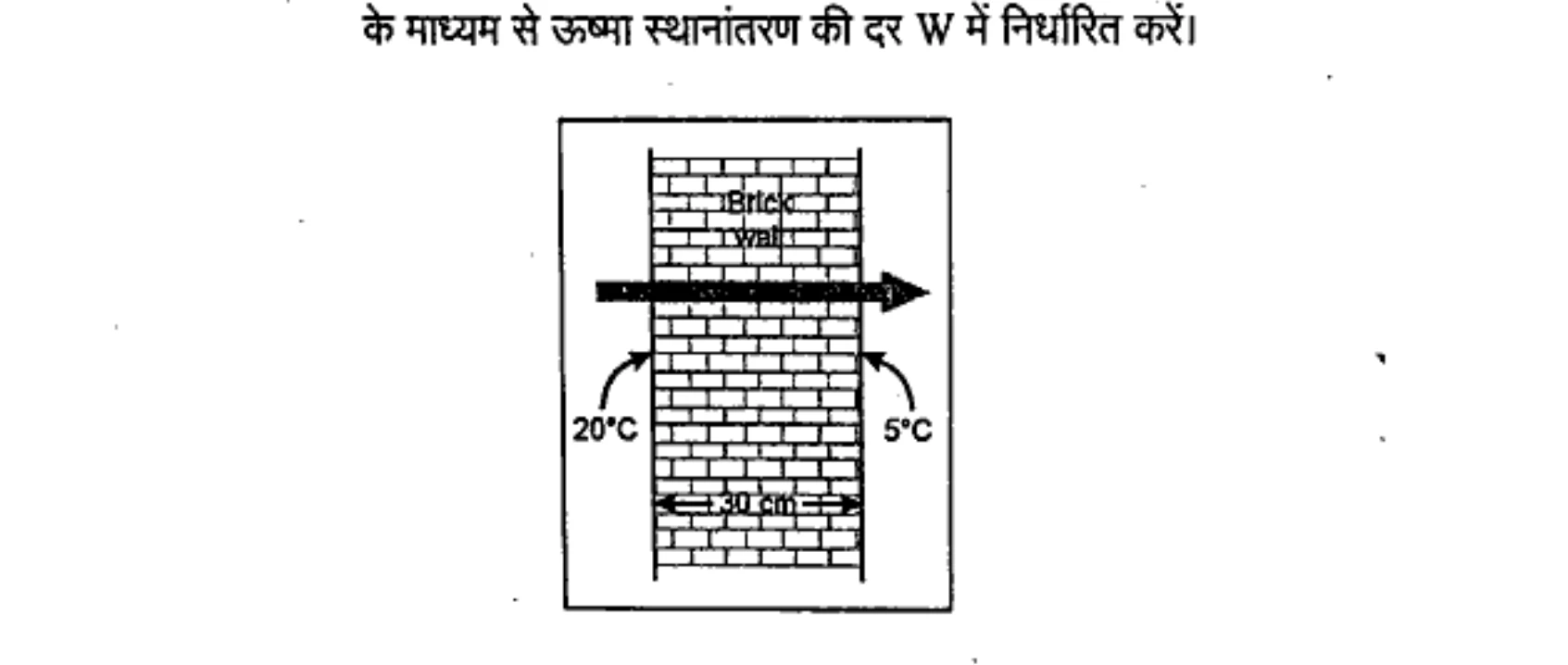
The inner and outer surfaces of a 5 × 6 m² brick wall of thickness 30 cm and thermal conductivity 0.69 W/m · °C are maintained at temperatures of 20°C and 5°C, respectively. Determine the rate of heat transfer through the wall, in W.
30 सेमी. मोटाई और 0.69 W/m · °C तापीय चालकता वाली 5 × 6 m² ईंट की दीवार की आंतरिक और बाहरी सतहों को क्रमशः 20°C और 5°C के तापमान पर बनाए रखा जाता है। दीवार के माध्यम से उष्मा स्थानांतरण की दर W में निर्धारित करें।
Define thermal resistance and thermal conductivity.
तापीय प्रतिरोध और तापीय चालकता को परिभाषित करें।
What is the significance of critical wall thickness?
क्रांतिक दीवार मोटाई का क्या महत्व है?
Derive an expression of general heat conduction equation in rectangular coordinates.
आयताकार निर्देशांकों में सामान्य उष्मा चालन समीकरण की अभिव्यक्ति व्युत्पन्न करें।
Consider a solid cylindrical rod of 0.15 m and diameter 0.05 m. The top and bottom surfaces of the rod are maintained at constant temperatures of 20°C and 95°C, respectively, while the side surface is perfectly insulated. Determine the rate of heat transfer through the rod if it is made of:
0.15 मीटर लंबाई और 0.05 मीटर व्यास वाली एक ठोस बेलनाकार छड़ पर विचार करें। छड़ की ऊपरी और निचली सतहों को क्रमशः 20°C और 95°C के स्थिर तापमान पर बनाए रखा जाता है, जबकि पार्श्व सतह पूरी तरह से इन्सुलेटेड होती है। छड़ के माध्यम से उष्मा स्थानांतरण की दर निर्धारित करें यदि यह किससे बनी है:
a) ताँबा, k = 380 W/m · °C
b) स्टील, k = 18 W/m · °C
c) ग्रेनाइट, k = 1.2 W/m · °C
If heat conduction is steady, one-dimensional, thermal conductivities are constant and no heat generation.
यदि उष्मा चालन स्थिर, एक-आयामी हो, तो तापीय चालकता स्थिर है और कोई उष्मा उत्पादन नहीं होता है।
What is the difference between the fin effectiveness and the fin efficiency?
फिन प्रभावशीलता और फिन दक्षता के बीच क्या अंतर है?
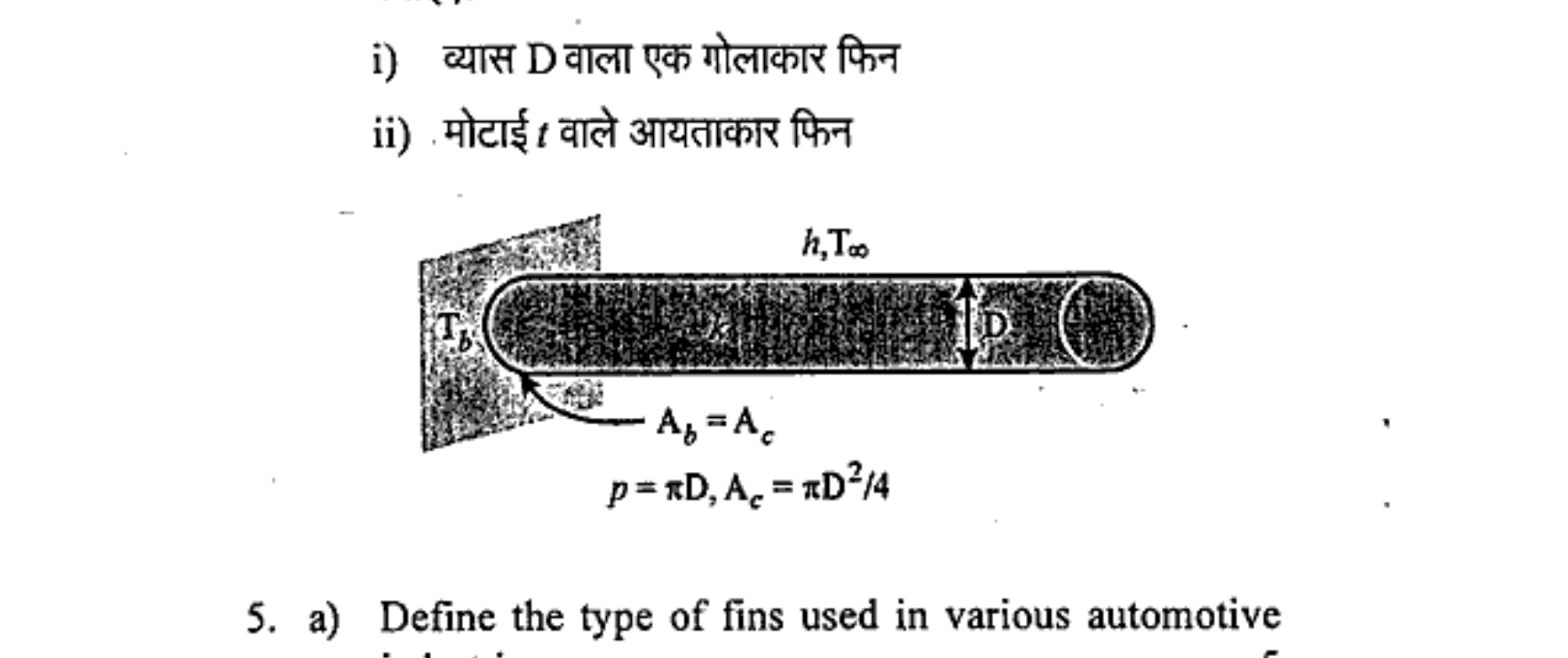
Obtain a relation for the fin efficiency for a fin of constant cross-sectional area Ap, perimeter P, length L and thermal conductivity k exposed to convection to a medium at Ta with a heat transfer coefficient h. Assume the fins are sufficiently long so that the temperature of the fin at the tip is nearly Ta. Take the temperature of the fin at the base to be To and neglect heat transfer from the fin tips. Simplify the relation for:
i) a circular fin of diameter D
ii) rectangular fins of thickness t.
Define the type of fins used in various automotive industries.
विभिन्न ऑटोमोटिव उद्योगों में प्रयुक्त फिन के प्रकार को परिभाषित करें।
What is the utility of extended surface?
विस्तारित सतह की उपयोगिता क्या है?
Consider two finned surfaces that are identical except that the fins on the first surface are formed by casting or extrusion, whereas they are attached to the second surface afterwards by welding or tight fitting. For which case do you think the fins will provide greater enhancement in heat transfer? Explain.
What is forced convection? How does it differ from natural convection?
बलपूर्वक संवहन क्या है? यह प्राकृतिक संवहन से किस प्रकार भिन्न है?
What is the physical significance of the Nusselt number? How is it defined?
नुसेल्ट संख्या का भौतिक महत्व क्या है? इसे कैसे परिभाषित किया जाता है?
A horizontal heated plate at 200°C and facing upwards has been placed in still air at 20°C. If the plate measures 1.25m × 1m. Calculate the heat loss by natural convection. The convective film coefficient for free convection is given by the following empirical relation:
200°C पर ऊपर की ओर मुख्य करके गर्म की गई एक क्षैतिज प्लेट को 20°C पर स्थिर हवा में रखा गया है। यदि प्लेट का माप 1.25 मीटर × 1 मीटर है। प्राकृतिक संवहन द्वारा उष्मा हानि की गणना करें। मुक्त संवहन के लिए संवहन फिल्म गुणांक निम्नलिखित अनुभवजन्य संबंध द्वारा दिया गया है:
Classify heat exchangers according to flow type and explain the characteristics of each type.
प्रवाह प्रकार के अनुसार ताप विनिमयकों को वर्गीकृत करें और प्रत्येक प्रकार की विशेषताओं को समझाएँ।
Establish the expression for log mean temperature difference for a counter flow heat exchanger.
प्रतिप्रवाह ताप एक्सचेंजर के लिए लॉग माध्य तापमान अंतर हेतु व्यंजक स्थापित करें।
Write short notes on any four of the followings.
i) Shape factor
ii) Black body
iii) Planck's law of the distribution
iv) Regimes of boiling
v) Radiation shield
vi) Nucleate boiling
निम्नलिखित में से किन्हीं चार पर संक्षिप्त टिप्पणी लिखें।
i) आकार कारक
ii) ब्लैक बॉडी
iii) प्लैंक का वितरण नियम
iv) उबलने की व्यवस्था
v) विकिरण परिरक्षण
vi) न्यूक्लियेट उबलना