Save as PDF
Opens your browser print dialog — select "Save as PDF" to download.
Total No. of Questions: 8
Total No. of Printed Pages : 6
[6]
Roll No.......................
AU/ME-404 (GS)
B.Tech. IV Semester
Examination, June 2023
Grading System (GS)
Fluid Mechanics
Time : Three Hours
Maximum Marks : 70
Note: i)
Answer any five questions.
किन्हीं पाँच प्रश्नों को हल कीजिए।
ii)
All questions carry equal marks.
सभी प्रश्नों के समान अंक हैं।
iii)
In case of any doubt or dispute the English version question should be treated as final.
किसी भी प्रकार के संदेह अथवा विवाद की स्थिति में अंग्रेजी भाषा के प्रश्न को अंतिम माना जायेगा।
6.
b)
Write the short note on Fanno and Rayleigh lines. Draw the Fanno and rayleigh lines on the h-s plot.
फैन्नो और रेले (Rayleigh) लाइनों पर संक्षिप्त टिप्पणी लिखिए। h-s प्लॉट पर फैन्न��� और रेले (Rayleigh) रेखाएँ खींचें।
8.
Write the short note on the following:
a)
Stagnation properties
b)
Normal and oblique shocks
c)
Compressible flow
d)
Mach number
निम्नलिखित पर संक्षिप्त टिप्पणी लिखिए।
अ)
ठहराव (Stagnation) गुण
ब)
सामान्य (Normal) और तिरछे (Oblique) झटके
स)
संपीडित (Compressible) प्रवाह
द)
मैक (Mach) संख्या
1.
a)
i)
Distinguish between ideal and real fluids.
ii)
How do you determine the hydrostatic force acting on an inclined surface?
iii)
What is metacentric height and what is its significance with respect to stability and periodic time of oscillation of a floating body?
b)
i)
आदर्श और वास्तविक तरल पदार्थों के बीच भेद करें।
ii)
आप एक झुकी हुई सतह पर अभिनय करने वाले हाइड्रोस्टेटिक बल का निर्धारण कैसे करते हैं?
iii)
मेटासेंट्रिक ऊंचाई क्या है और एक तैरते हुए पिंड के दोलन की स्थ��रता और आवधिक समय के संबंध में इसका क्या महत्व है?
b)
What is the physical significance of mathematical terms, ΔV and Δ×V in fluid mechanics? Where, V is the 3D velocity vector of the fluid flow.
द्रव यांत्रिकी में गणितीय शब्दों, ΔV और Δ×V का भौतिक महत्व क्या है? जहाँ V द्रव प्रवाह का 3D वेग सदिश है।
2.
For the velocity field, V = $(y^2 + 6x - 3x^2)i + (3xy^2 - 6y - x^2)j$, check whether the flow is
i)
continuous
ii)
rotational or irrotational
iii)
if irrotational, find potential function.
वेग क्षेत्र के लिए, V = $(y^2 + 6x - 3x^2)i + (3xy^2 - 6y - x^2)j$, जाँचें कि क्या प्रवाह है
i)
निरंतर
ii)
घूर्णी या परिक्रमणोत्पन्न
iii)
यदि अघूर्णीय है, तो विभव (पोटेंशियल) फलन ज्ञात कीजिए।
3.
a)
Explain the terms:
i)
Path line
ii)
Streak line
iii)
Stream line
iv)
Stream tube
शब्दों की व्याख्या करें।
i)
पथ रेखा
ii)
स्ट्रीक लाइन
iii)
स्ट्र���म लाइन
iv)
स्ट्रीम ट्यूब
b)
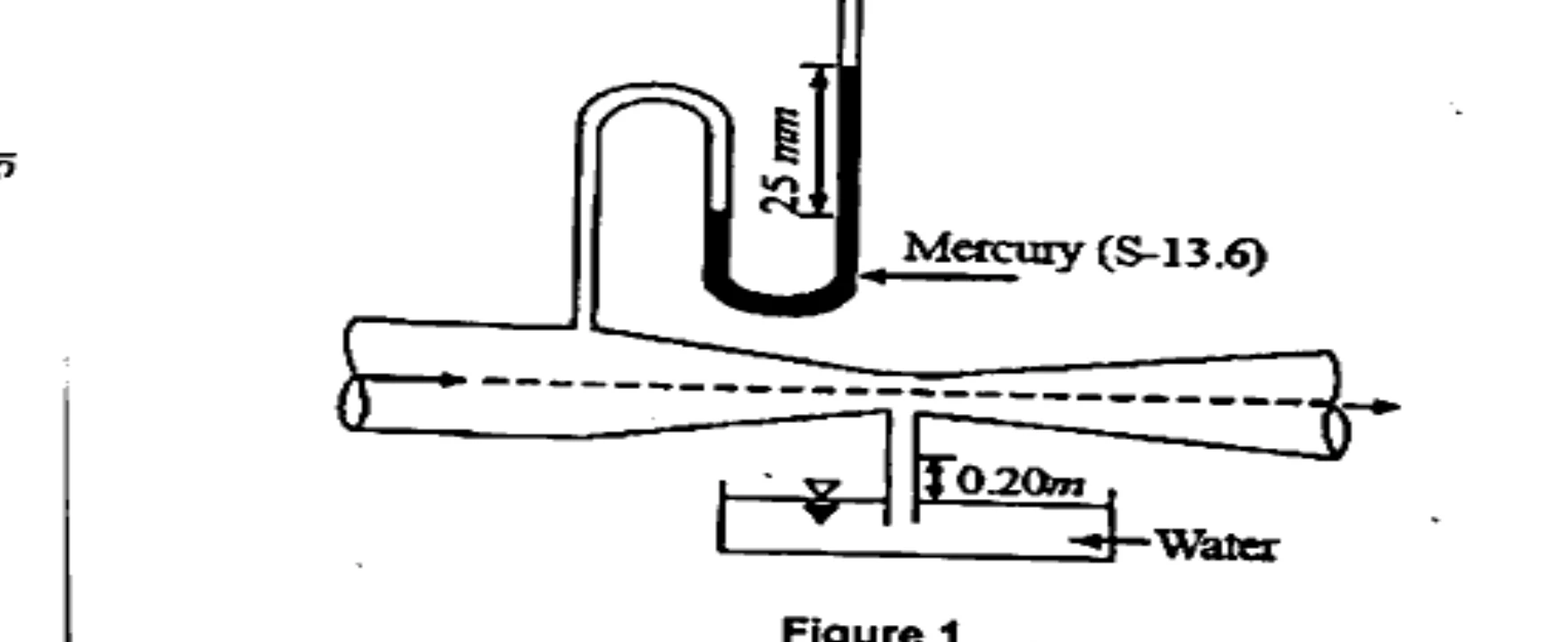
For a discharge of 2.1 m³/s of air through a pipe of area 0.093 m², determine the area of throat of a venturimeter as shown in Figure 1. Take specific weight of air as 11.96 N/m³ and neglect losses.
0.093 m² क्षेत्र के एक पाइप के माध्यम से 2.1 m³/s हवा के निर्वहन के लिए एक वेंचुरिमीटर के गले के क्षेत्र को निर्धारित करें जैसा कि ��ित्र 1 (Figure 1) में दिखाया गया है। हवा का विशिष्ट भार 11.96 N/m³ लें और नुकसान की उपेक्षा करें।
4.
a)
Distinguish between:
i)
Steady flow and un-steady flow
ii)
Uniform and non-uniform flow
iii)
Compressible and incompressible flow
iv)
Rotational and irrotational flow
v)
Laminar and turbulent flow
निम्नलिखित में अंतर करें।
i)
स्थिर प्रवाह और अस्थिर प्रवाह
ii)
यूनिफार्म और नॉन यूनिफार्म प्रवाह
iii)
संपीडित और असंपीडित प्रवाह
iv)
घूर्णि और परिक्रमणोन्मुख प्रवाह
v)
लैमिनार और टर्बुलेंट बहाव
b)
A stream function is given by $(\chi^2-y^2)$. Find the potential function of the flow.
एक धारा फलन $(\chi^2-y^2)$ द्वारा दिया जाता है। प्रवाह का संभावित फलन ज्ञात कीजिए।
5.
a)
A vertical isosceles triangular gate is immersed in water with its vertex up. The base width of gate is 2 m and height 1.5 m. The vertex of gate is 1m below the free water surface. Determine the total pressure force and its location.
एक ऊर्ध्वाधर समद्विबाहु त्रिभुजाकार गेट पानी में डूबा हुआ है और उसका शीर्ष ऊपर की ओर है। गेट की आधार चौड़ाई 2 मीटर और ऊँचाई 1.5 मीटर है। गेट का शीर्ष मुक्त पानी की सतह से 1 मीटर नीचे है। कु��� दबाव बल और उसके स्थान का निर्धारण करें।
b)
Derive Bernoulli's equation for flow along a stream line.
धारा रेखा के अनुदिश प्रवाह के लिए बरनौली का समीकरण व्युत्पन्न कीजिए।
6.
a)
A conical turbulent bearing idealized as a cone of vertex angle 60°, maximum cone diameter 200 mm, rests in revolves about vertex over a uniform fluid layer of thickness 1 mm at 600 rpm. If viscosity of fluid is 1 Poise, calculate the power lost in overcoming the viscous resistance.
b)
Water at 25°C is flowing through a 1.0 km long G.I. pipe of 200 mm diameter at the rate of 0.07 m³/s. If value of Darcy friction factor for this pipe is 0.02 and density of water is 1000 kg/m³, find the pumping power (in kW) required to maintain the flow?
25°C पर जल 1.0 किमी लंबे G.I. से बह रहा है। 0.07 m³/s की दर से 200 मिमी व्यास का पाइप। यदि इस पाइप के लिए डार्सी घर्षण कारक का मान 0.02 है और पानी का घनत्व 1000 किग्रा/घन मीटर है, तो प्रवाह को बनाए रखने के लिए आवश्यक पंपिंग शक्ति (किलोवाट में) ज्ञात कीजिए।
7.
a)
Two pipes each 300 m long are available for connecting to a reservoir from which a flow of 0.085 m³/s is required. If diameters of the two pipes are 300 mm and 150 mm respectively, determine the ratio of head lost when the pipes are connected in series to the head lost when connected in parallel. Neglect minor losses.
एक जलाशय से जुड़ने के लिए प्रत्येक पाइप 300 मीटर लंबे दो पाइप उपलब्ध हैं, जिसमें से 0.085 m³/s के प्रवाह की आवश्यकता होती है। यदि दो पाइपों के व्यास क्रमशः 300 मिमी और 150 मिमी हैं, तो सिरी के खोए हुए सिर का अनुपात निर्धारित करें जब पाइप श्रृंखला में जुड़े होते हैं और समानांतर में जुड़े होने पर खोए हुए सिर से। मामूली नुकसान की उपेक्षा करें।