Save as PDF
Opens your browser print dialog — select "Save as PDF" to download.
AU/ME-403
B.Tech./B.Tech. (Working Professional) IV Semester
Examination, June 2025
Grading System (GS)/Working Professional
Theory of Machines
Note: i) Attempt any five questions. किसी पाँच प्रश्नों को हल कीजिए।
ii) All questions carry equal marks. सभी प्रश्नों के समान अंक हैं।
iii) In case of any doubt or dispute the English version question should be treated as final. किसी भी प्रकार के संदेह अथवा विवाद की स्थिति में अंग्रेजी भाषा के प्रश्न को अंतिम माना जायेगा।
Design a Whitworth quick return motion mechanism shown in Figure to have the following particulars: 7
Return stroke = 200 mm
Time ratio of working to return stroke = 2
Length of driving crank = 50 mm
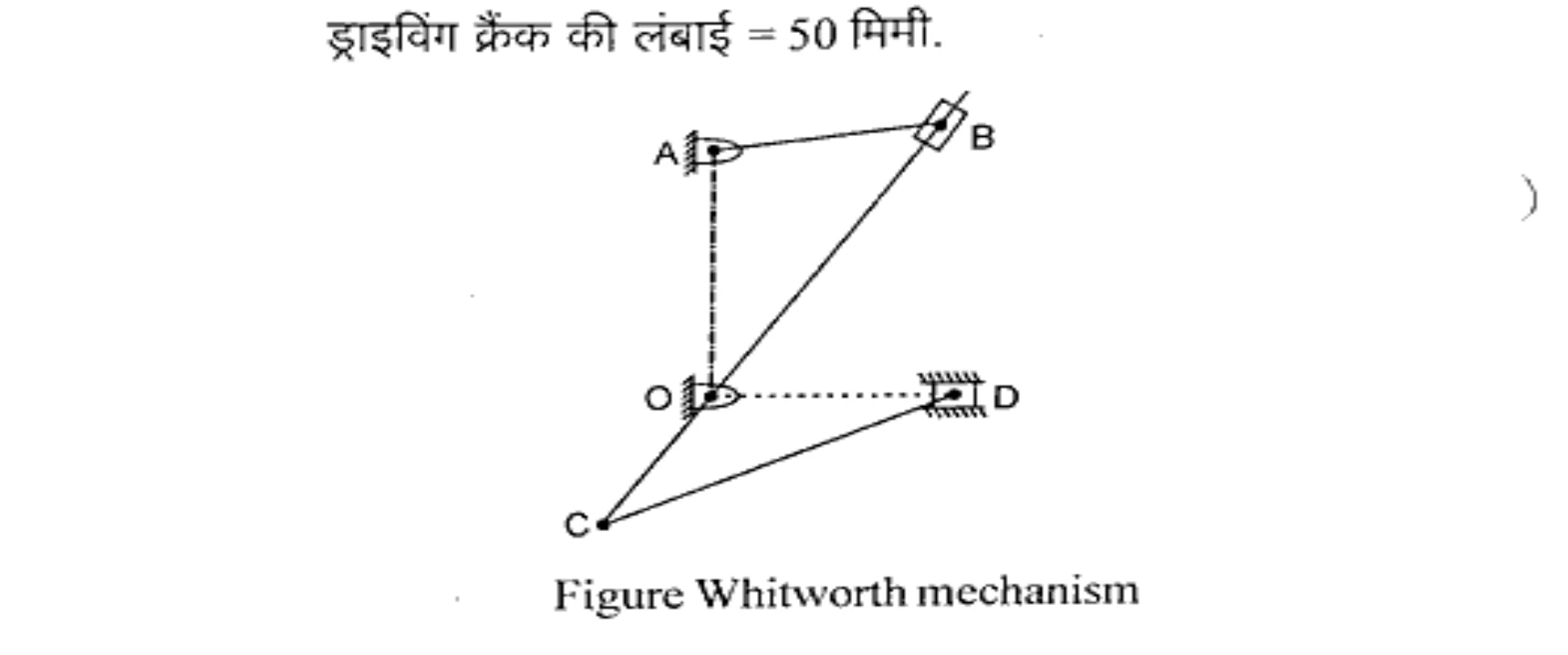
Figure Whitworth mechanism
Define mechanisms and machines, and differentiate between them. Explain the concept of degree of freedom in a mechanism. 7
तंत्र और मशीनों को परिभाषित करें तथा उनके बीच अंतर बताइए। तंत्र में स्वतंत्रता की डिग्री की अवधारणा को समझाइए।
Differentiate between number synthesis and motion analysis. Explain the analytical and graphical methods used for dynamic motion analysis, highlighting their advantages and limitations. 7
संख्या संश्लेषण और गति विश्लेषण के बीच अंतर बताइए। गतिशील गति विश्लेषण के लिए उपयोग की जाने वाली विश्लेषणात्मक और ग्राफिकल विधियों की व्याख्या कीजिए, उनके लाभ और सीमाओं पर प्रकाश डालिए।
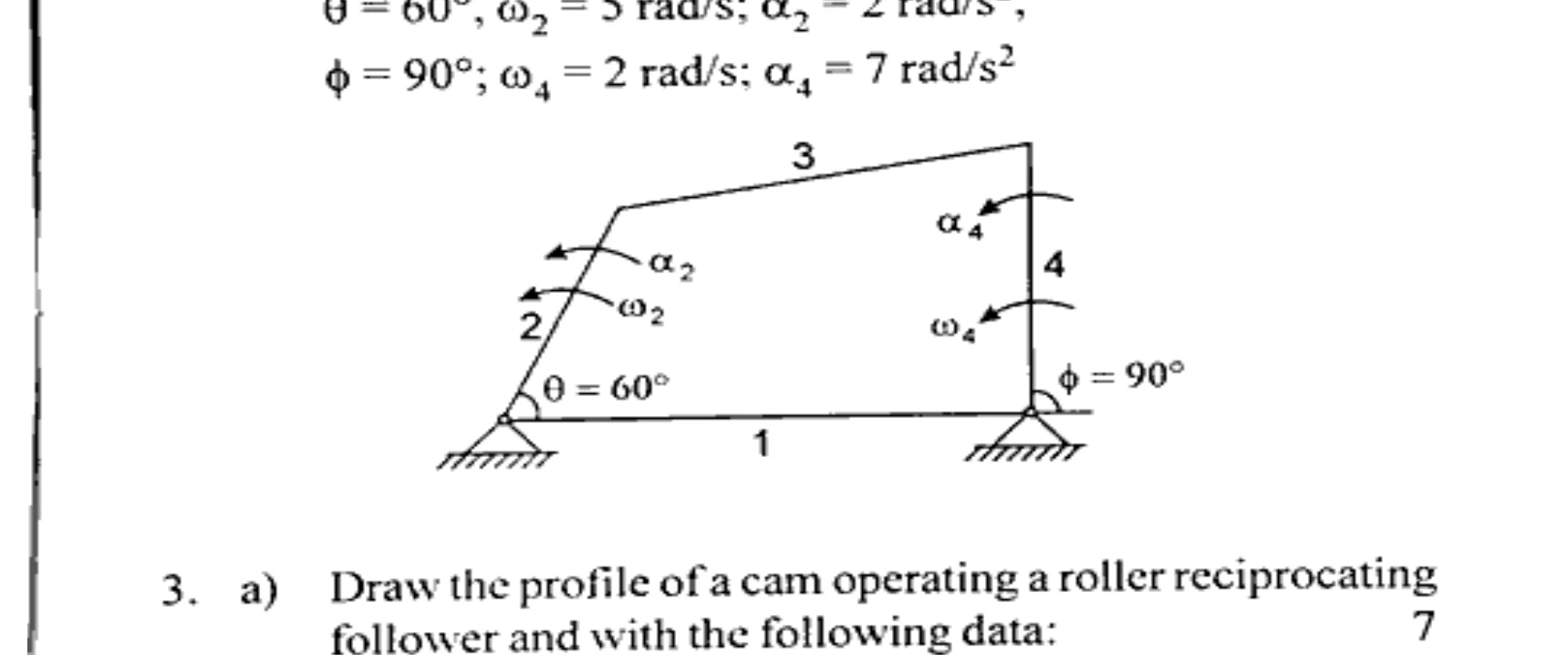
Synthesize a four bar linkage, as shown in Fig., Freudenstein's equation to satisfy in one of its positions. The specification of position θ, velocity ω and acceleration α are as follows: 7
θ = 60°; ω₁ = 5 rad/s; α₁ = 2 rad/s²;
θ = 90°; ω₂ = 2 rad/s; α₂ = 7 rad/s²
चित्र में दिखाए गए फोरबार लिंकेज को फ्रायडेनस्टीन के समीकरण के अनुसार संश्लेषित करें ताकि स्थिति में उसकी एक स्थिति को संतुष्ट कर सकें। स्थिति θ, वेग ω और त्वरण α का विनिर्देशन इस प्रकार है :
θ = 60°; ω₁ = 5 rad/s; α₁ = 2 rad/s²;
θ = 90°; ω₂ = 2 rad/s; α₂ = 7 rad/s²
Draw the profile of a cam operating a reciprocating follower and with the following data: 7
Minimum radius of cam = 25 mm
Lift = 30 mm
Roller diameter = 15 mm
The cam lifts the follower for 120° with SHM followed by a dwell period of 30°. Then the follower lowers down during 150° of the cam rotation with uniform acceleration and deceleration followed by a dwell period. If the cam rotates at a uniform speed of 150 rpm, calculate the maximum velocity and acceleration of the follower during the descend period.
Describe various friction devices used in power transmission, such as pivot and collars, power screws, and clutches. Discuss the classifications of clutches and their applications. 7
पावर ट्रांसमिशन में उपयोग किए जाने वाले विभिन्न घर्षण उपकरणों का वर्णन करें, जैसे पिवट और कॉलर, पॉवर स्क्रू और क्लच। क्लच के वर्गीकरण और उनके अनुप्रयोगों पर चर्चा करें।
Define the following terms as applied to cam with a neat sketch: 7
i) Base circle
ii) Pressure angle
iii) Prime circle
iv) Pitch circle
v) Stroke of the follower
vi) Undercutting
कैम पर लागू निम्नलिखित शब्दों को एक साफ रेखाचित्र के साथ परिभाषित करें।
i) बेस सर्कल
ii) दबाव कोण
iii) प्राइम सर्कल
iv) पिच सर्कल
v) फॉलोअर का स्ट्रोक
vi) अंडरकटिंग
Explain briefly the differences between simple, compound, and epicyclic gear trains. What are the special advantages of epicyclic gear trains? 7
सरल, मिश्रित और एपिसाइक्लिक गियर ट्रेनों के बीच अंतर को संक्षेप में समझाइए। एपिसाइक्लिक गियर ट्रेनों के विशेष लाभ क्या हैं?
A pair of spur gears with involute teeth is to give a gear ratio of 4:1. The arc of approach is not to be less than the circular and smaller wheel is the driver. The angle of pressure is 14.5°. Find: 7
i) the least number of teeth that can be used on each wheel
ii) the addendum of the wheel in terms of the circular pitch?
Explain the concept of inversions and illustrate with the example of a four-bar mechanism. 7
उत्क्रमण की अवधारणा को समझाइए तथा चार-बार तंत्र के उदाहरण से स्पष्ट कीजिए।
Show that, in a band and block brake, the ratio of the maximum and minimum tensions in the brake strap is 7
T₀ / Tn = ( (1 + μ tan θ) / (1 - μ tan θ) )n
where
T₀ = Maximum tension
Tn = Minimum tension
μ = Coefficient of friction between the blocks and drum,
2θ = Angle subtended by each block at the centre of the drum.
जहाँ
T₀ = अधिकतम तनाव
Tn = न्यूनतम तनाव
μ = ब्लॉक और ड्रम के बीच घर्षण गुणांक
2θ = ड्रम के केंद्र पर प्रत्येक ब्लॉक द्वारा बनाया गया कोण
Determine the maximum, minimum, and average pressure in plate clutch when the axial force is 4 kN. The inside radius of the contact surface is 50 mm and the outside radius is 100 mm. Assume uniform wear. 7
अक्षीय बल 4 kN होने पर प्लेट क्लच में अधिकतम, न्यूनतम और औसत दबाव निर्धारित करें संपर्क सतह की अंदरूनी त्रिज्या 50 मिमी. और बाहरी त्रिज्या 100 मिमी. है। एकसमान घिसाव मान लें।
Discuss briefly with neat sketches the longitudinal, transverse and torsional free vibrations. 7
अनुदैर्ध्य, अनुप्रस्थ और मरोड़ मुक्त कंपनों पर स्पष्ट रेखाचित्रों के साथ संक्षेप में चर्चा करें।
Derive an expression for the magnitude and direction of coriolis component of acceleration. 7
त्वरण के कोरियोलिस घटक के परिमाण और दिशा के लिए व्यंजक व्युत्पन्न करें।
Four masses M1, M2, M3 and M4 are 200kg, 300kg, 240kg and 260 kg, respectively. The corresponding radii of rotation are 0.2m, 0.15m, 0.25m and 0.3m respectively and the angle between successive masses are 45°, 75° and 135°. Find the position and magnitude of balance mass required if its radius of rotation is 0.25m. 7
चार द्रव्यमान M1, M2, M3 और M4 क्रमशः 200 किग्रा., 300 किग्रा., 240 किग्रा. और 260 किग्रा. है। घूर्णन की संगत त्रिज्याएँ क्रमशः 0.2 मीटर, 0.15 मीटर, 0.25 मीटर और 0.3 मीटर है और क्रमिक द्रव्यमानों के बीच का कोण 45°, 75° और 135° है। यदि घूर्णन की त्रिज्या 0.25 मीटर है, तो आवश्यक संतुलन द्रव्यमान की स्थिति और परिमाण ज्ञात कीजिए।
******