Save as PDF
Opens your browser print dialog — select "Save as PDF" to download.
[6]
Total No. of Questions : 8
Total No. of Printed Pages : 6
Roll No.......................
CY-405 (GS)
B.Tech., IV Semester
Examination, June 2023
Grading System (GS)
Database Management System
Time : Three Hours
Maximum Marks : 70
Note: i)
Answer any five questions.
किन्हीं पाँच प्रश्नों को हल कीजिए।
ii)
All question carries equal marks.
सभी प्रश्न के समान अंक हैं।
iii)
In case of any doubt or dispute the English version question should be treated as final.
किसी भी प्रकार के संदेह अथवा विवाद की स्थिति में अंग्रेजी भाषा के प्रश्न को अंतिम माना जावेगा।
8. a)
What is Secondary storage? Explain types of data storage in DBMS and describe storage hierarchy.
7
सेकेंडरी स्टोरेज क्या है? DBMS में डेटा स्टोरेज के प्रकारों को समझाइए और स्टोरेज पदानुक्रम का वर्णन कीजिए।
b)
Distinguish between:
7
- Primary and Secondary indexing.
- Ordered indexing and hashing.
अंतर करें।
- प्राथमिक और माध्यमिक अनुक्रमण
- अनुक्रमण और हैशिंग का आदेश दिया
[2]
[3]
2. a)
Define degree and cardinality. Based upon the given table write degree and cardinality.
7
डिग्री और कार्डिनैलिटी की परिभाषा दीजिए। दी गई तालिका के आधार पर डिग्री और कार्डिनैलिटी लिखिए।
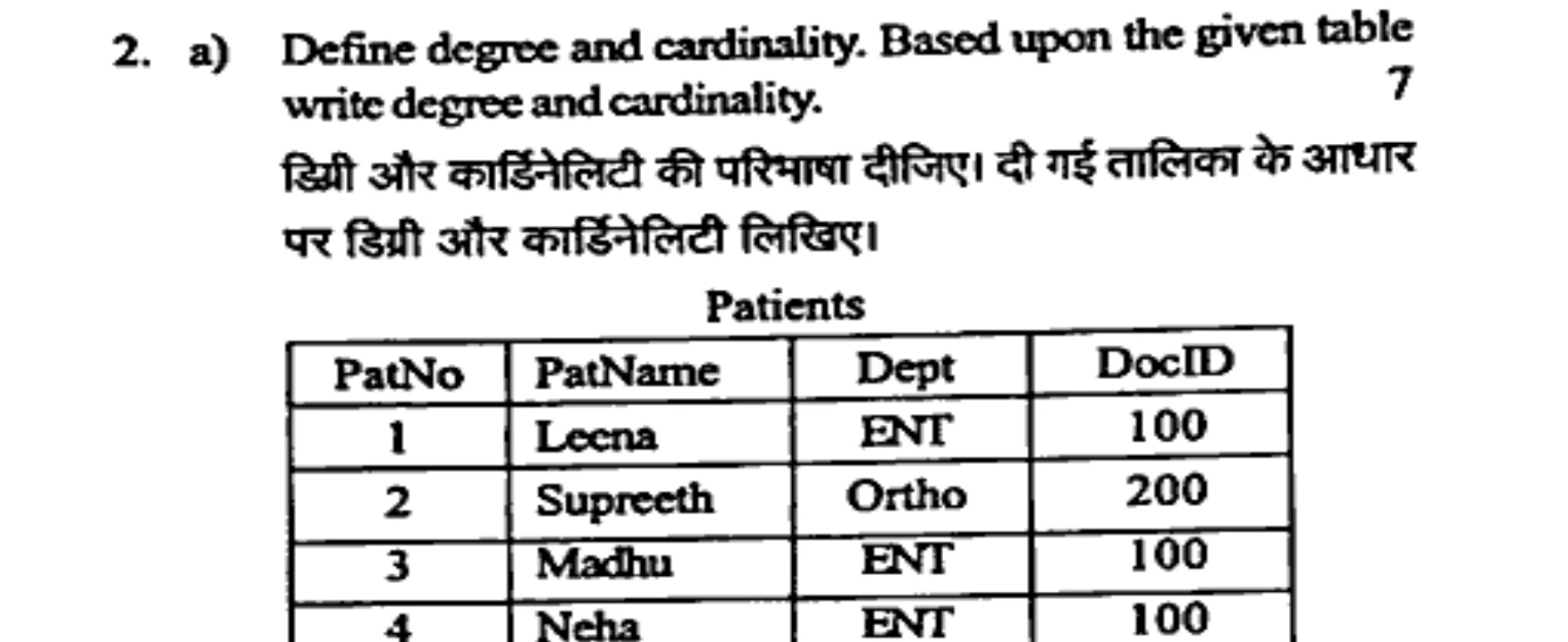
Patients
| PatNo | PatName | Dept | DocID |
|---|---|---|---|
| 1 | Leena | ENT | 100 |
| 2 | Supreeth | Ortho | 200 |
| 3 | Madhu | ENT | 100 |
| 4 | Neha | ENT | 100 |
| 5 | Deepak | Ortho | 200 |
b)
What is the meaning of ACID characteristics in relational databases? Define the structure of a relational database schema.
7
रिलेशनल डेटाबेस में ACID विशेषताओं का क्या अर्थ है? रिलेशनल डेटाबेस स्कीमा की संरचना को परिभाषित करें।
3. a)
Describe the different types of keys. Explain different operations in Relational algebra.
7
विभिन्न प्रकार की कुंजियों का वर्णन करें। संबंधपरक बीजगणित में विभिन्न संक्रियाओं को समझाइए।
b)
Consider the student table given below.
7
नीचे दी गई छात्र तालिका पर विचार करें।
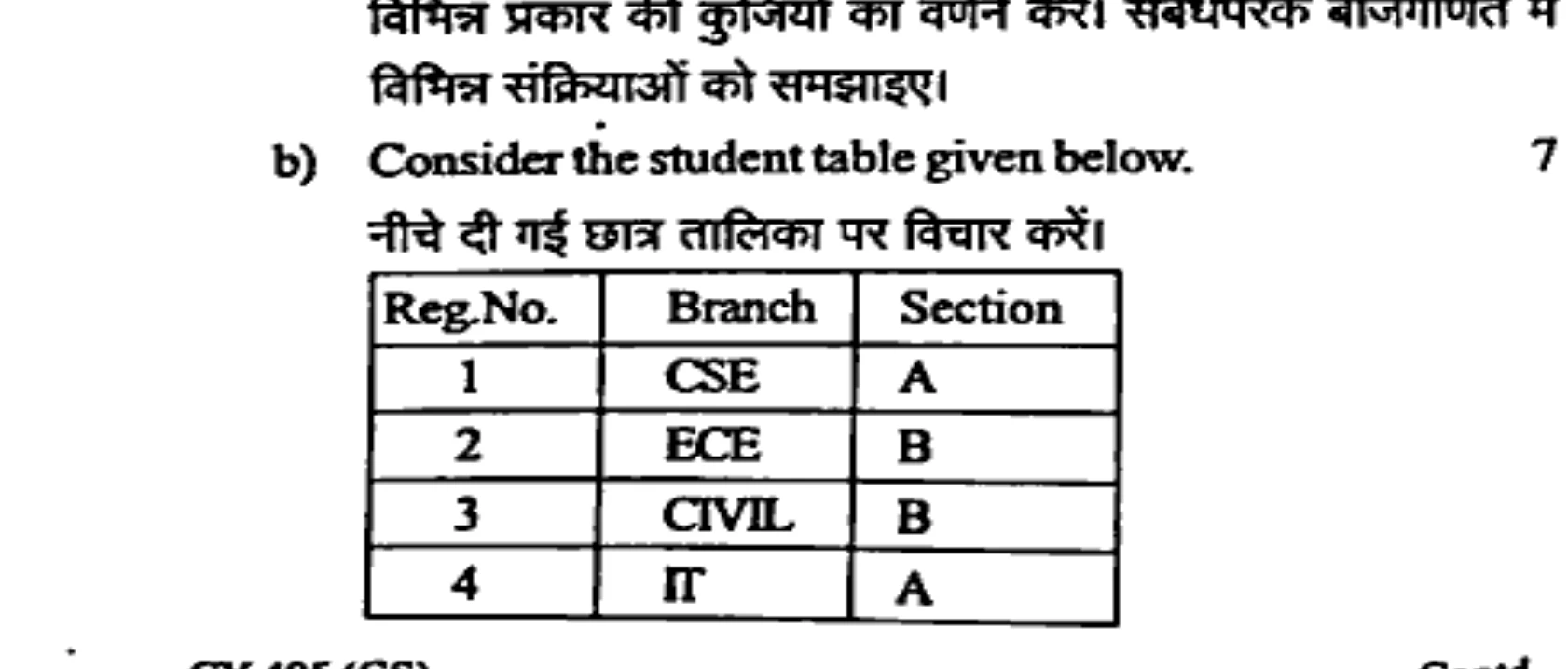
| Reg.No. | Branch | Section |
|---|---|---|
| 1 | CSE | A |
| 2 | ECE | B |
| 3 | CIVIL | B |
| 4 | IT | A |
Write commands (using relational algebra operations), and outputs for the followings:
- To display all the records of student table.
- To display all the records of CSE branch in student table.
- To display the record of ECE branch section B students.
- To display the records of section B CSE and IT branch.
- To display all the records in student tables whose regno>2.
निम्नलिखित के लिए आदेश (संबंधपरक बीजगणित संचालन का उपयोग करके) और आउटपुट लिखें:
- छात्र तालिका के सभी रिकॉर्ड प्रदर्शित करने के लिए।
- छात्र तालिका में CSE शाखा के सभी रिकॉर्ड प्रदर्शित करने के लिए।
- ECE शाखा अनुभाग B के छात्रों का रिकॉर्ड प्रदर्शित करने के लिए।
- अनुभाग B CSE और IT शाखा के रिकॉर्ड प्रदर्शित क��ने के लिए।
- छात्र तालिकाओं में सभी रिकॉर्ड प्रदर्शित करने के लिए जिनके regno>2।
[4]
[5]
5. b)
Suppose you are given a relation R = (A, B, C, D, E) with the following functional dependencies. (CE→D, D→B, C→A).
7
- Find all candidate keys.
- Identify the best normal form that R satisfies (1NF, 2NF, 3NF, or BCNF).
- If the relation is not in BCNF, decompose it until it becomes BCNF. At each step, identify a new relation, decompose and re-compute the keys and the normal forms they satisfy.
मान लीजिए कि आपको निम्नलिखित कार्यात्मक निर्भरता के साथ एक संबंध R = (A, B, C, D, E) दिया गया है। (CE→D, D→B, C→A)।
- सभी उम्मीदवार कुंजी खोजें।
- R को संतुष्ट करने वाले सर्वोत्तम सामान्य रूप की पहचान करें (1NF, 2NF, 3NF या BCNF)।
- यदि संबंध BCNF में नहीं है, तो इसे BCNF बनने तक विघटित करें। प्रत्येक चरण में, एक नए संबंध की पहचान करें, कुंजी और सामान्य रूपों को संतुष्ट कर���ं और फिर से गणना करें।
5. a)
Let R=(A, B, C, D, E, F) be a relation scheme with the following dependencies: C→F, E→A, EC→D, A→B. Find candidate key for R?
7
R=(A, B, C, D, E, F) को निम्नलिखित निर्भरताओं के साथ एक संबंध योजना बनने दें। C→F, E→A, EC→D, A→B। R के लिए उम्मीदवार कुंजी खोजें।
6. b)
The following functional dependencies are given:
7
AB→CD, AF→D, DE→F, C→G, F→E, G→A
Find the closure of CF, BG, AB and AF.
निम्नलिखित कार्यात्मक निर्भरता दी गई है:
AB→CD, AF→D, DE→F, C→G, F→E, G→A
CF, BG, AB और AF का समापन ज्ञात कीजिए।
6. a)
What do you mean by Serializability? Discuss the conflict and view serializability with suitable example.
7
क्रमबद्धता से आप क्या समझते हैं? संघर्ष पर चर्चा करें और उपयुक्त उदाहरण के साथ क्रमबद्धता देखें।
7. a)
What do you mean by Multiple granularities? How is it implemented in transaction system?
7
एकाधिक ग्रेन्युलैरिटी से आप क्या समझते हैं? इसे लेनदेन प्रणाली में कैसे लागू किया जाता है?
7. a)
What are the methods used for deadlock prevention in DBMS? What is difference between blocking and deadlock?
7
DBMS में गतिरोध की रोकथाम के लिए किन विधियों का उपयोग किया जाता है? अवरोधन और गतिरोध में क्या अंतर है?
7. b)
What is Checkpoint in DBMS? Why is Checkpoint used in database? How Checkpoint works in DBMS?
7
DBMS में चेकपॉइंट क्या है? डेटाबेस में चेकपॉइंट का उपयोग क्यों किया जाता है? DBMS में चेकपॉइंट कैस��� काम करता है?