Save as PDF
Opens your browser print dialog — select "Save as PDF" to download.
CS-601 (GS)
B.Tech., VI Semester
Examination, May 2023
Grading System (GS)
Machine Learning
Note: i) Attempt any five questions.
किन्हीं पाँच प्रश्नों को हल कीजिए।
ii) All Questions carry equal marks.
सभी प्रश्नों के समान अंक हैं।
iii) In case of any doubt or dispute the English version question should be treated as final.
किसी भी प्रकार के संदेह अथवा विवाद की स्थिति में अंग्रेजी भाषा के प्रश्न को अंतिम माना जायेगा।
Explain various types of machine learning used for continuous data and non-continuous data.
सतत डाटा और गैर-निरंतर डाटा के लिए उपयोग किए जाने वाले विभिन्न प्रकार के मशीन लर्निंग की व्याख्या करें।
Give an explanation of the One-hot encoding as well as the Label encoding. In what ways do they change the dimensionality of the data that has been provided?
एक-हॉट एन्कोडिंग के साथ-साथ लेबल एन्कोडिंग का स्पष्टीकरण दें। प्रदान किए गए डाटा की आयामीता को वे किस तरह से बदलते हैं?
Break down how CNN actually operates. The image is downscaled, and the number of filters is increased as we approach the model's output, but why?
तोड़ें कि CNN वास्तव में कैसे काम करता है? छवि को छोटा किया जाता है, और जैसे-जैसे हम मॉडल के आउटपुट तक पहुंचते हैं, फिल्टर की संख्या बढ़ जाती है, लेकिन क्यों?
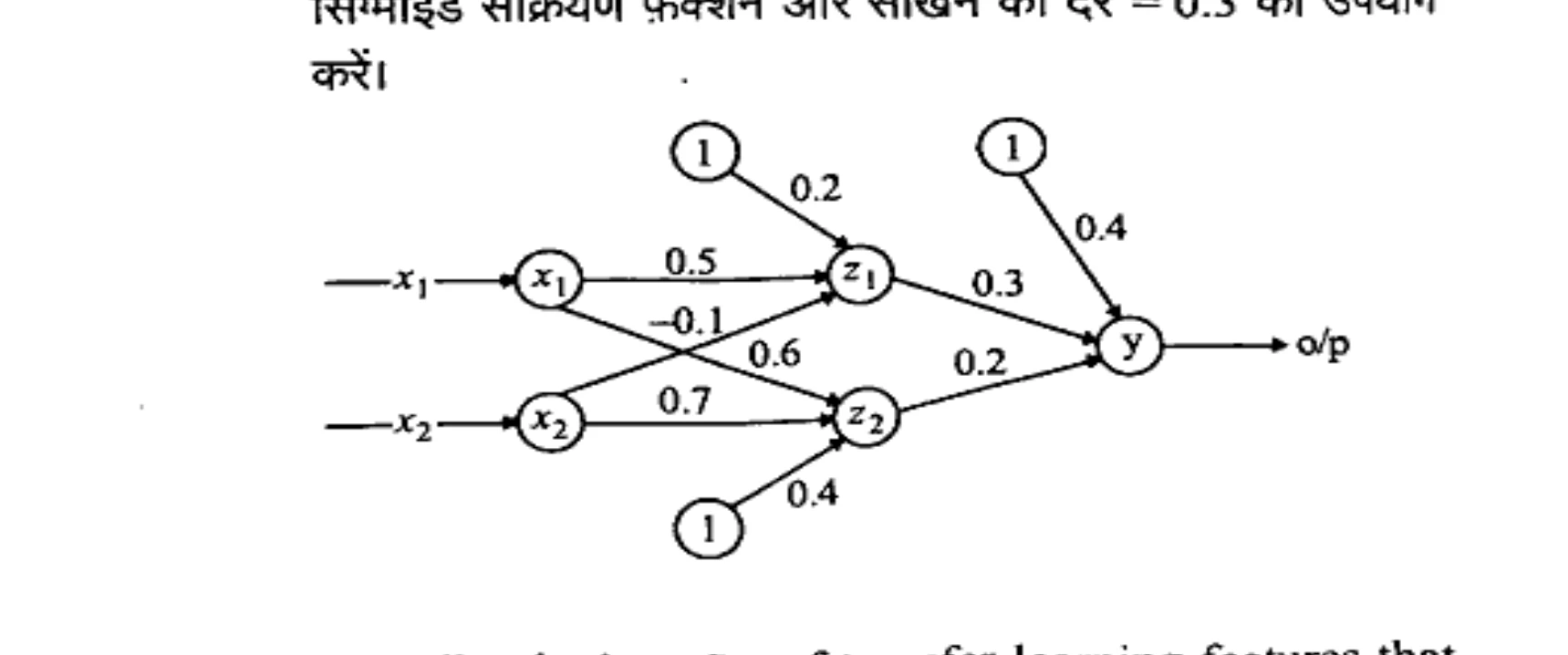
Replace the old weights (not the bias) in the network depicted in the following figure using back-propagation algorithms. A [0,1] input pattern is given to the network, and the desired output is 1. Use the Sigmoid activation function and a learning rate of = 0.3.
बैक-प्रोपगेशन एल्गोरिथम का उपयोग करके निम्न आकृति में दर्शाए गए नेटवर्क में पुराने वजन (पूर्वाग्रह नहीं) को बदलें। नेटवर्क को एक A [0,1] इनपुट पैटर्न दिया गया है, और वांछित आउटपुट 1 है। सिग्मॉइड सक्रियण फ़ंक्शन और सीखने की दर = 0.3 का उपयोग करें।
Describe the benefits of transfer learning features that can be transferred. Explain Inception net architecture in detail.
ट्रांसफर लर्निंग सुविधाओं के लाभों का वर्णन करें जिन्हें स्थानांतरित किया जा सकता है। इंसेप्शन नेट आर्किटेक्चर को विस्तार से समझाएं।
What are the structural and operational differences between a feed-forward network and a recurrent neural network? Identify the differences between LSTM, GRU, and vanilla RNNs.
एक फीड-फॉरवर्ड नेटवर्क और आरपार तांत्रिका नेटवर्क के बीच संरचनात्मक और परिचालन अंतर क्या हैं? LSTM, GRU और वैनिला RNN के बीच अंतर को पहचानें।
Differentiate:
Various loss functions
विभिन्न हानि कार्य
Types of Gradient Descent Optimizers
ग्रेडिएंट डिसेंट ऑप्टिमाइज़र के प्रकार
Clarify the meaning of Confusion metrics in the context of machine learning. What other metrics might be derived from the metric of confusion?
मशीन लर्निंग के संदर्भ में कन��फ्यूजन मैट्रिक्स का अर्थ स्पष्ट करें। भ्रम के मेट्रिक से अन्य कौन-से मेट्रिक प्राप्त किए जा सकते हैं?
"Model performance can be greatly improved through careful hyperparameter tuning". Justify the statement.
"सावधानीपूर्वक हाइपरपैरामीटर ट्यूनिंग के माध्यम से मॉडल के प्रदर्शन में काफी सुधार किया जा सकता है।" कथन का औचित्य सिद्ध कीजिए।
Explain how the KNN method is informed by information regarding a player's speed and agility that will be used to determine whether he will be drafted into the team. Predict the likelihood that a player with "speed = 6.75" and "agility = 3" will make the team using the KNN machine learning model assuming "k = 3".
समझाएँ कि KNN पद्धति कैसे लागू की जाती है? नीचे एक खिलाड़ी की गति और चपलता के बारे में जानकारी दी हुई है जिसका उपयोग यह निर्धारित करने के लिए किया जाएगा कि उसे टीम में शामिल किया जाएगा या नहीं। इस संभावना की भविष्यवाणी करें कि "गति = 6.75" और "चपलता = 3" वाला खिलाड़ी "k = 3" मानकर KNN मशीन लर्निंग मॉडल का उपयोग करके टीम बनाएगा।
| ID | Speed | Agility | Draft |
|---|---|---|---|
| 11 | 2.00 | 2.00 | no |
| 12 | 5.00 | 2.50 | no |
| 13 | 8.25 | 8.50 | no |
| 14 | 5.75 | 8.75 | yes |
| 15 | 4.75 | 6.25 | yes |
| 16 | 5.50 | 6.75 | yes |
| 17 | 5.25 | 9.50 | yes |
| 18 | 7.00 | 4.25 | yes |
| 19 | 7.50 | 8.00 | yes |
| 20 | 7.25 | 5.75 | yes |
How can we make the model non-linear? If we only use linearity, how will that affect Gradient Descent?
हम मॉडल को अरेखीय कैसे बना सकते हैं? यदि हम केवल रैखिकता का उपयोग करते हैं, तो यह ग्रेडिएंट डिसेंट को कैसे प्रभावित करेगा?
Based on figure, which depicts the Bayesian belief network for the data set shown in the table below, respond to the following questions. (Assume that each attribute has a binary value.)
चित्र के आधार पर, जो नीचे दी गई तालिका में दिखाए गए डेटा सेट के लिए बायेसियन विश्वास नेटवर्क को दर्शाता है, निम्नलिखित प्रश्नों का उत्तर दें। (मान लें कि प्रत्येक विशेषता का एक बाइनरी मान है)।
| Mileage | Engine | Air Conditioner | No. of Records with Car Value = High | No. of Records with Car Value = Low |
|---|---|---|---|---|
| Hi | Good | Working | 3 | 4 |
| Hi | Good | Broken | 1 | 2 |
| Hi | Bad | Working | 1 | 5 |
| Hi | Bad | Broken | 0 | 4 |
| Lo | Good | Working | 9 | 0 |
| Lo | Good | Broken | 5 | 1 |
| Lo | Bad | Working | 1 | 2 |
| Lo | Bad | Broken | 0 | 2 |
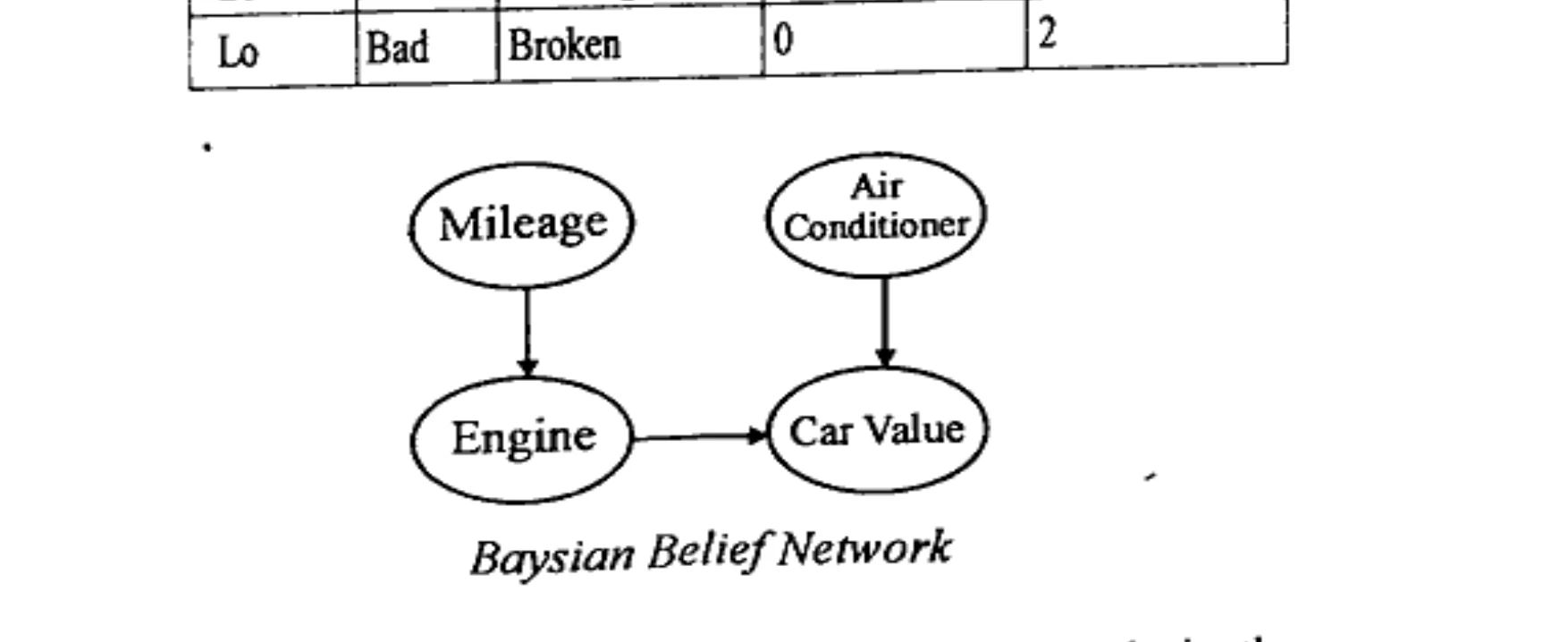
Draw the probability table for each node in the network.
नेटवर्क में प्रत्येक नोड के लिए प्रायिकता तालिका बनाइए।
Use the Bayesian network to predict the 'car value' for the following.
निम्नलिखित के लिए 'कार मूल्य' की भविष्यवाणी करने के लिए बायेसियन नेटवर्क का उपयोग करें।
P(Mileage = Lo, Engine = Bad,
Air Conditioner = Broken)
Describe the procedure that can be used to identify overfitting and underfitting in a CNN model. Include some potential solutions to this problem as well.
उस प्रक्रिया का वर्णन करें जिसका उपयोग CNN मॉडल में ओवरफिटिंग और अंडरफिटिंग की पहचान करने के लिए किया जा सकता है। इस समस्या के कुछ संभावित समाधान भी शामिल करें।
Explain the following with an appropriate example:
Computer Vision
कंप्यूटर दृष्टि
Reinforcement learning
सुदृढीकरण सीखना