Save as PDF
Opens your browser print dialog — select "Save as PDF" to download.
Total No of Questions: 8
[2]
Total No of Printed Pages : 6
Roll No ................................
CE-501 (GS)
B.Tech., V Semester
Examination, June 2025
Grading System (GS)
Fluid Mechanics - I
Time : Three Hours
Maximum Marks : 70
Note:
- Attempt any five questions. किन्हीं पाँच प्रश्नों को हल कीजिए।
- All questions carry equal marks. सभी प्रश्नों के समान अंक हैं।
- Assume suitable data, if required and mention it clearly. यदि आवश्यक हो तो उपयुक्त डाटा मान लें और उसका स्पष्ट उल्लेख करें।
- In case of any doubt or dispute the English version question should be treated as final. किसी भी प्रकार के संदेह अथवा विवाद की स्थिति में अंग्रेजी भाषा के प्रश्न को अंतिम माना जायेगा।
1.
a) What is manometer? What are the different types of manometer?
मैनोमीटर क्या है? मैनोमीटर के विभिन्न प्रकार क्या हैं?
b) Differentiate the following:
निम्नलिखित में अंतर करें।
- Absolute and gauge pressure निरपेक्ष और गेज दबाव
- Dynamic viscosity and kinematic viscosity गतिशील चिपचिपापन और गतिज चिपचिपापन
- Cohesion and adhesion संसंजन और आसंजन
2.
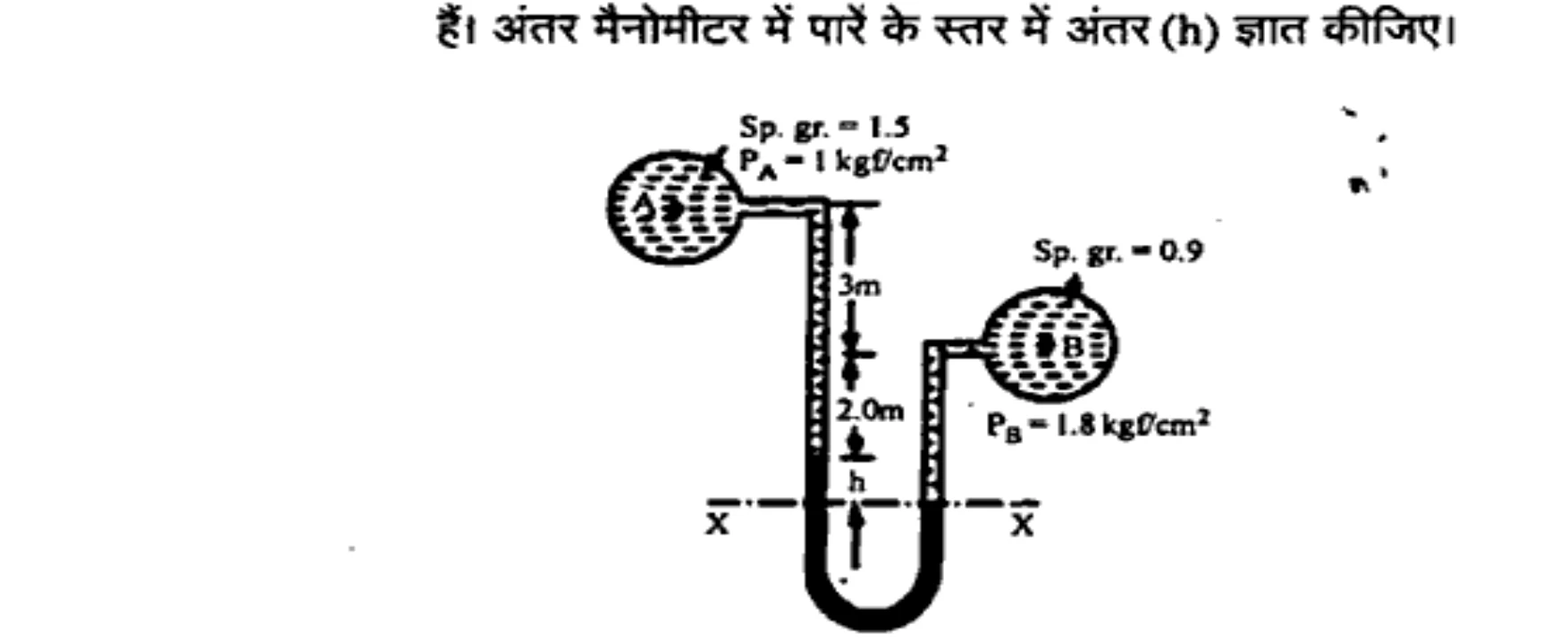
a) A differential manometer is connected at the two points A and B of two pipes. The pipe A contains a liquid of sp. gr. 1.5 while pipe B contains a liquid of sp. gr. 0.9. The pressures at A and B are 1 kgf / cm² and 1.8 kgf/cm² respectively. Find the difference in mercury level in the differential manometer (h).
दो पाइपों के दो बिंदुओं A और B पर एक अंतर मैनोमीटर जुड़ा हुआ है। पाइप A में sp. gr. 1.5 का द्रव है जबकि पाइप B में sp. gr. 0.9 का द्रव है। A और B पर दबाव क्रमशः 1 kgf / cm² और 1.8 kgf/cm² है। अंतर मैनोमीटर में पारे के स्तर में अंतर (h) ज्ञात कीजिए।
3.
c) Define the distinguish the following:
निम्नलिखित में अंतर स्पष्ट करें।
- streamlines and streak lines धारा रेखार और धारियाँ
- rotational and irrotational flow घूर्णनी और अघूर्णी प्रवाह
a) If Φ = 3xy, find X and y components of velocity at (1,3), (1,3) and (3,3). Determining discharge passing between streamlines passing through these points.
यदि Φ = 3xy, तो (1,3) और (3,3) पर वेग के X और y घटक ज्ञात कीजिए। इन बिंदुओं से गुजरने वाली धारा रेखाओं के बीच से गुजरने वाले निर्वहन का निर्धारण करें।
b) What is a flow net? Briefly discuss any one method of drawing a flow net.
फ्लो नेट क्या है? फ्लो नेट बनाने की किसी एक विधि पर संक्षेप में चर्चा करें।
4.
a) The actual velocity of a liquid issuing through a 7 cm diameter orifice fitted in a open tank is 6 m/s under a head of 3 m. If the discharge measured in a collecting tank is 0.020 m³/s, calculate the coefficient of velocity, coefficient of contraction and the theoretical discharge through the orifice.
एक खुले टैंक में लगे 7 सेमी. व्यास के छिद्र से निकलने वाले द्रव का व��स्तविक वेग 3 मीटर के शीर्ष के नीचे 6 मीटर/सेकंड है। यदि एक संग्रह टैंक में मापा निर्वहन 0.020 m³/s है, तो वेग के गुणांक, संकुचन के गुणांक और छिद्र के माध्यम से सैद्धांतिक निर्वहन की गणना करें।
b) Compare and contrast the discharge of venturimeter, flow nozzle and orifice meter as primary element for flow measurement.
प्रवाह माप के लिए प्राथमिक तत्व के रूप में वेंचुरीमीटर, प्रवाह नोजल और ओरिफिस मीटर क��� निर्वहन की तुलना और अंतर बताइए।
5.
a) Write the Bernoulli's equation and explain the terms in it. What are the assumptions made in deriving Bernoulli's equation?
बरनौली समीकरण लिखें और उसमें दिए गए पदों की व्याख्या करें। बरनौली समीकरण निकालने में क्या-क्या मान्यताएँ रखी गई हैं?
b) Differentiate the following:
निम्नलिखित में अंतर बताएं।
- laminar flow and turbulent flow i) लेमिनार प्रवाह और अशांत प्रवाह
- smooth surface and rough surface ii) चिकनी सतह और खुरदरी सतह
6.
a) What is the significance of Reynold's number? Oil flows in a pipe 80 mm bore diameter with a mean velocity of 0.4 m/s. The density is 890 kg/m³ and the viscosity is 0.075 Ns/m². Show that the flow is laminar and hence deduce the pressure loss per metre length.
रेनॉल्ड संख्या का क्या महत्व है? 80 मिमी. बोर व्यास वाले पाइप में तेल 0.4 मीटर/सेकंड के औसत वेग से बहता है। घनत्व 890 kg/m³ है और श्यानता 0.075 Ns/m² है। दिखाइए कि प्रवाह लेमिनार है और इसलिए प्रति मीटर लंबाई में दबाव हानि का अनुमान लगाइए।
7.
b) What is meant by geometric, kinematic and dynamic similarities? Are these similarities truly attainable or not?
ज्यामितीय, गतिज और गत्यात्मक समानताओं का क्या अर्थ है? क्या ये समानताएँ वास्तव में प्राप्त करने योग्य हैं या नहीं?
a) The resistance R experienced by a partially submerged body depends upon the velocity v, length of the body l, viscosity of the fluid μ, density of the fluid ρ and gravitational acceleration g. Using Buckingham's pi theorem, determine an expression for R.
आंशिक रूप से डूबे हुए पिंड द्वारा अनुभव किया जाने वाला प्रतिरोध R, वेग v, पिंड की लंबाई l, द्रव की श्यानता μ, द्रव के घनत्व ρ और गुरुत्वाकर्षण त्वरण g पर निर्भर करता है। बकिंगहम के पाई प्रमेय का उपयोग करके, R के लिए एक व्यंजक निर्धारित करें।
c) How do you derive Darcy Weisbach equation?
आप डार्सी वेसबैक समीकरण कैसे व्युत्पन्न करेंगे?
8.
Write short notes on the following (any four):
निम्नलिखित पर संक्षिप्त टिप्पणियाँ लिखें। (कोई चार)
- Buckingham's Π Theorem बकिंगहम का Π प्रमेय
- Stokes law स्टोक्स नियम
- Pitot tube पिटोट ट्यूब
- Stream function स्ट्रीम फंक्शन
- Buoyant force उत्प्लावन बल
- Friction factor घर्षण कारक