Save as PDF
Opens your browser print dialog — select "Save as PDF" to download.
Total No. of Questions : 8
Total No. of Printed Pages : 6
[2]
Roll No ...................................
AD/AL/AI-304 (GS)
B.Tech, III Semester
Examination, December 2023
Grading System (GS)
Artificial Intelligence
Time : Three Hours
Maximum Marks : 70
Note:
- Attempt any five questions.
- किन्हीं पाँच प्रश्नों को हल कीजिए।
- All questions carry equal marks.
- सभी प्रश्नों के समान अंक हैं।
- In case of any doubt or dispute the English version question should be treated as final.
- किसी भी प्रकार के संदेह अथवा विवाद की स्थिति में अंग्रेजी भाषा के प्रश्न को अंतिम माना जायेगा।
1. a)
Four approaches of AI are Acting Humanly, Thinking Humanly, Thinking rationally and Acting rationally. Discuss feasibility of the approaches in current scenario. Which approach is best suitable for rational agent and why?
7
AI के चार दृष्टिकोण मानवीय रूप से कार्य करना, मानवीय रूप से सोचना, तर्कसंगत रूप से सोचना और तर्कसंगत रूप से कार्य करना है। वर्तमान परिदृश्य में दृष्टिकोणों की व्यवहार्यता पर चर्चा करें। तर्क संगत एजेंट के लिए कौन-सा दृष्टिकोण सबसे उपयुक्त है और क्यों?
b)
Explain how A* search different with AO* search technique. Discuss the advantage and disadvantage of both the techniques?
7
यथाख्या करें कि कैसे A* खोज AO* खोज तकनीक से भिन्न है? दोनों तकनीकों के लाभ और हानि पर चर्चा करें।
2. a)
State the difference between informed search and uninformed search with suitable example.
7
उपयुक्त उदाहर�� के साथ सूचित खोज और बेखबर खोज के बीच अंतर बताएं।
b)
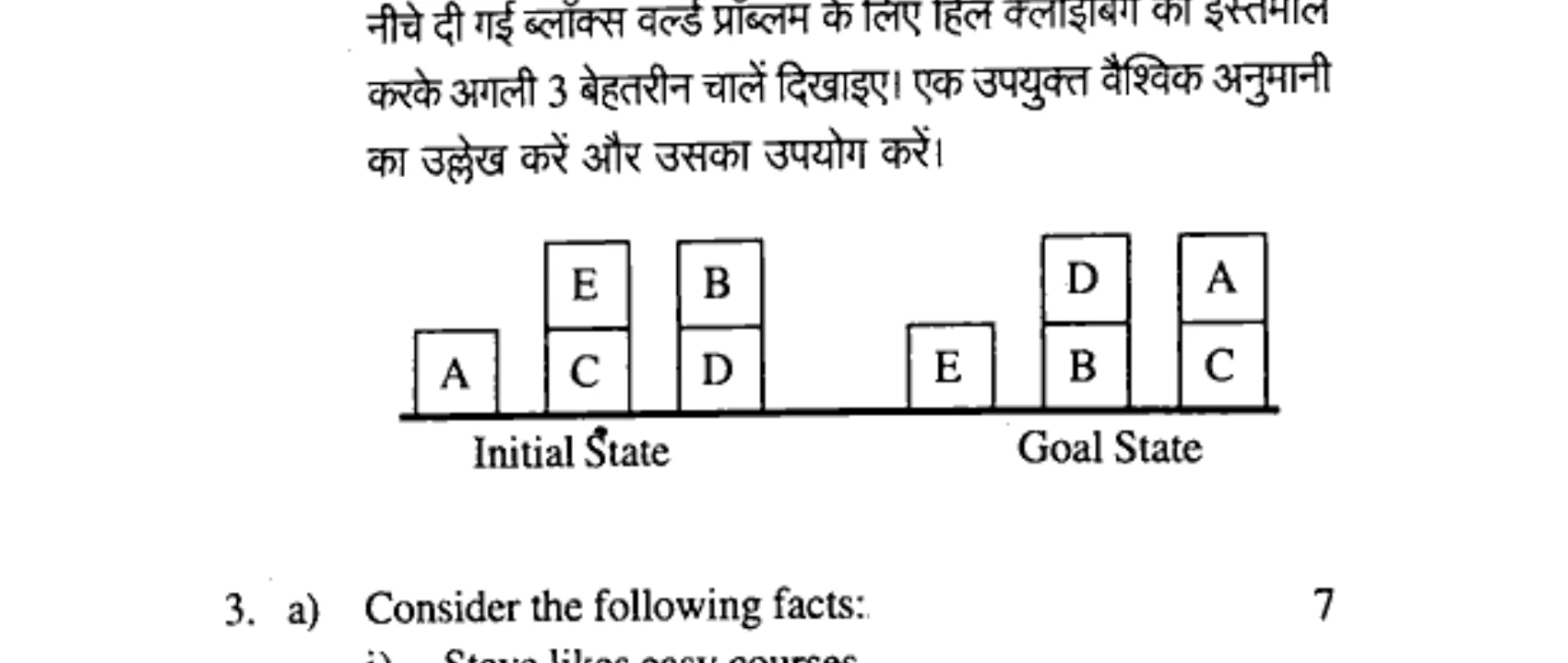
For the Blocks World problem given below, use Hill Climbing to show the next 3 best moves. State and use a suitable global heuristic.
7
नीचे दी गई ब्लॉक्स वर्ल्ड प्रॉब्लम के लिए हिल क्लाइंब्ग का इस्तेमाल करके अगली 3 बेहतरीन चालें दिखाइए। एक उपयुक्त वैश्विक अनुमानों का उल्लेख करें और उसका उपयोग करें।
3. a)
Consider the following facts:
7
- Steve likes easy courses
- Science courses are hard
- All the courses in the CSE department are easy
- CS3101 is a CSE department course
- Translate these into predicate logic.
- Convert them into clausal form.
- Using resolution prove "What course would Steve like".
- स्टीव को आसान पाठ्यक्रम पसंद है।
- विज्ञान पाठ्यक्रम कठिन हैं।
- CSE विभाग में सभी पाठ्यक्रम आसान हैं।
- CS3101 CSE विभाग का पाठ्यक्रम है।
- इनको विधेय तर्क में अनुवाद करें।
- उन्हें क्लॉजि फॉर्म में परिवर्तित करें।
- संकल्प का उपयोग करके साबित करें कि 'स्टीव को कौन-सा कोर्स पसंद आएगा''।
[4]
b)
Describe the difference between Depth First Search (DFS) and Breadth First Search (BFS) with suitable example.
7
डेप्थ फर्स्ट सर्च (DFS) और ब्रेड़थ फर्स्ट सर्च (BFS) के बीच उपयुक्त उदाहरण के साथ अंतर का वर्णन करें।
4. a)
What are the key advantages of using Bayes theorem compared to other probability frameworks?
7
अन्य संभाव्यता ढांचे की तुलना में बेयस प्रमेय का उपयोग करने के मुख्य लाभ क्या हैं?
b)
Consider the following graph
10
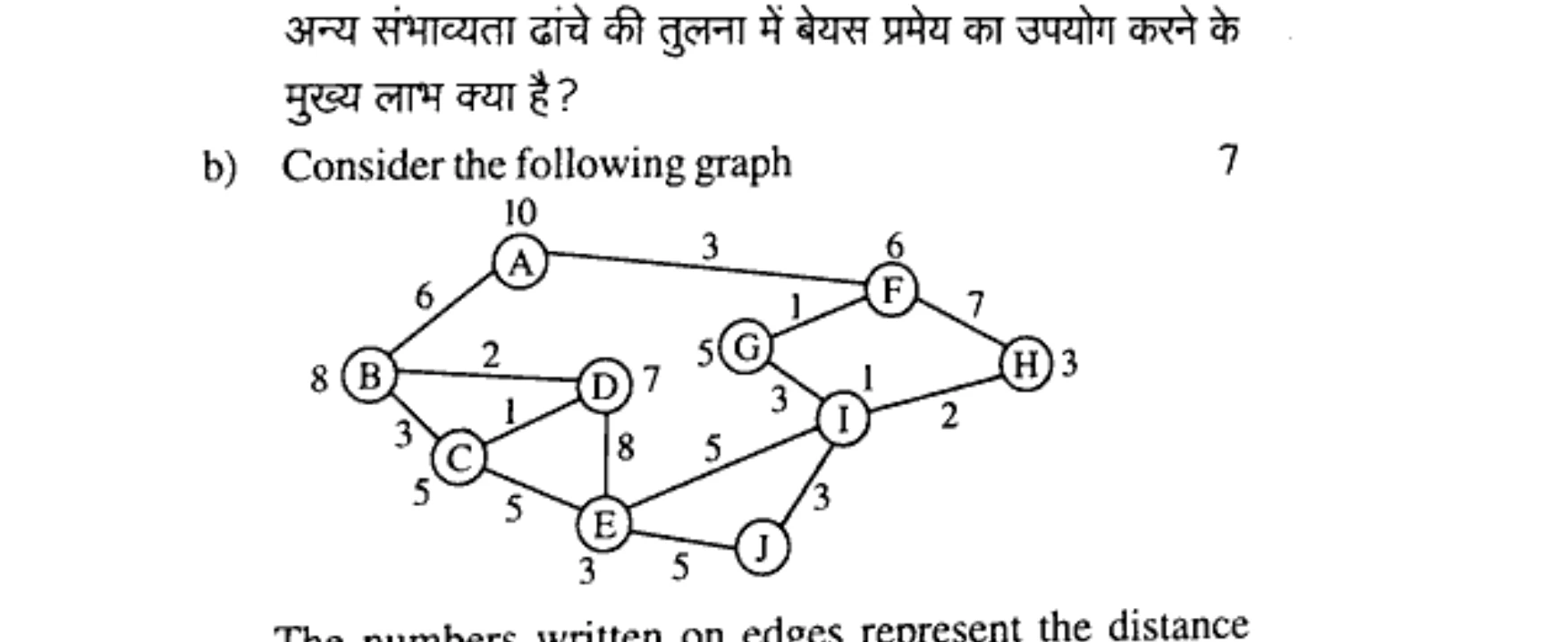 The numbers written on edges represent the distance between the nodes. The numbers written on nodes represent the heuristic value.
Find the most cost-effective path to reach from start state A to final state J using A* Algorithm.
The numbers written on edges represent the distance between the nodes. The numbers written on nodes represent the heuristic value.
Find the most cost-effective path to reach from start state A to final state J using A* Algorithm.
5. a)
Write short notes on:
7
- Propositional logic
- First Order Predicate logic
- प्रस्तावपरक तर्क
- प्रथम कोटि विधेय तर्क
b)
How would you define Natural Language Processing (NLP) and its significance in today's technological landscape?
7
���्राकृतिक भाषा प्रसंस्करण (NLP) और आज के तकनीकी परिदृश्य में इसके महत्व को आप कैसे परिभाषित करेंगे?
6. a)
What are the key advantage and limitations of expert systems in the field of Artificial Intelligence?
7
आर्टिफिशियल इंटेलिजेंस के क्षेत्र में विशेषज्ञ प्रणालियों के मुख्य लाभ और सीमाएं क्या हैं?
[6]
b)
What are the main differences between forward chaining and backward chaining in expert systems, and when would you prefer to use each approach?
7
विशेषज्ञ प्रणालियों में फॉरवर्ड चेनिंग और बैकवर्ड चेनिंग के बीच मुख्य अंतर क्या है, और आप प्रत्येक दृष्टिकोण का उपयोग कब करना पसंद करेंगे?
7. a)
Consider a state space where the start state is number 1 and the successor function for state n returns two states, numbers 2n and 2n+1.
7
- Draw the portion of the state space for states 1 to 15.
- Suppose the goal state is 11. List the order in which nodes will be visited for breadth-first search, depth-first search with limit 3.
- 1 से 15 तक के स्टेट के लिए स्टेट स्थान का भाग बनाइए।
- मान लें कि लक्ष्य स्थिति 11 है। उस क्रम को सूचीबद्ध करें जिसमें ब्रिड़्थ-फर्स्ट सर्च, डेप्थ-फर्स्ट सर्च सीमा 3 के लिए नोड्स का दौरा किया जाएगा।
b)
The heuristic values for each state are shown below. Given these values, draw a diagram in that illustrates the search tree of explored states, using A* search (the path cost is still a unit cost). Indicate the calculated cost at each node in the tree.
7
प्रत्येक स्टेट के लिए अनुमानों मान नीचे ��िखाए गए हैं। इन मूल्यों को देखते हुए, A* सर्च (पथ लागत अभी भी एक इकाई लागत है) का उपयोग करते हुए, खोजे गए स्टेट के सर्च ट्री को दिखाता है जिसमें आरम्भ बताएँ। ट्री में प्रत्येक नोड पर परिकलित लागत का संकेत दें।
A: 9      G: 3
B: 4      H: 5
C: 5      I: 8
D: 7      J: 2
E: 3      K: 0
F: 10     L: 7
8. a)
Consider following tree:
7
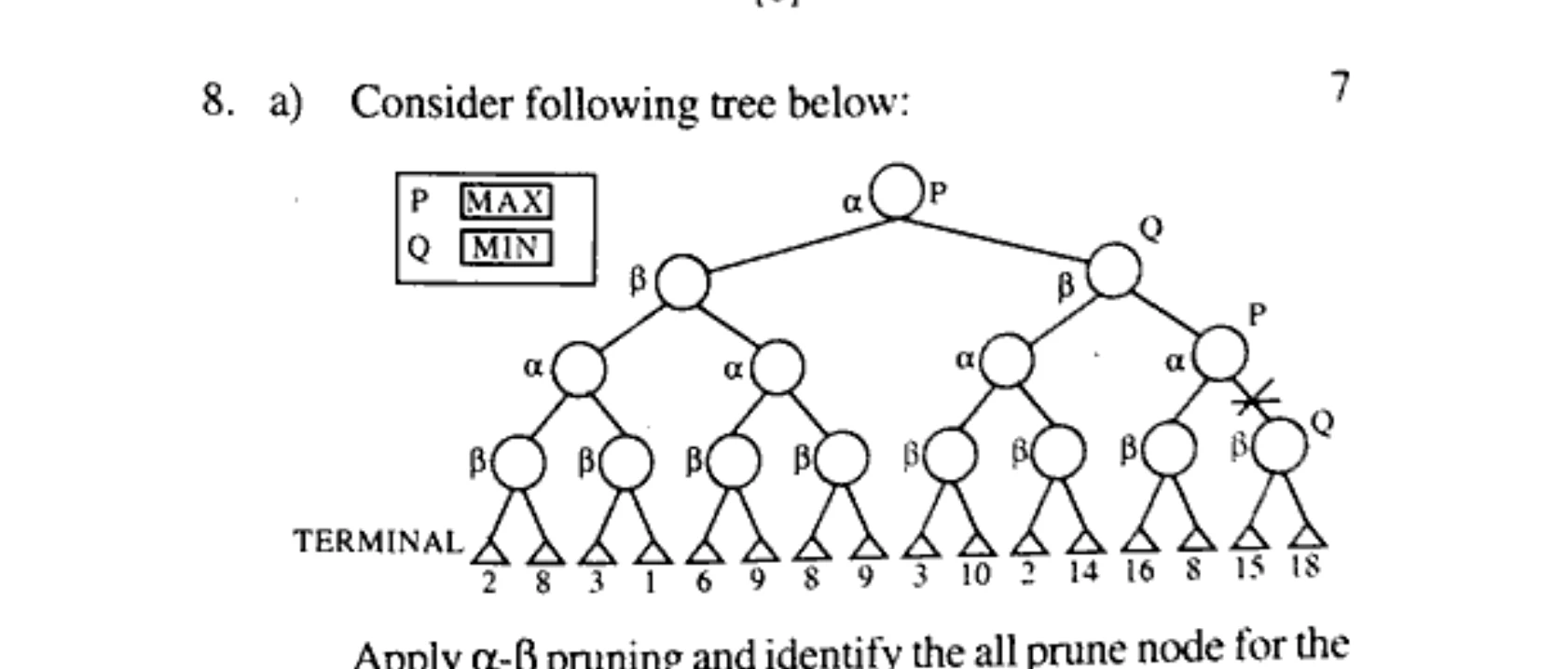 Apply α-β pruning and identify the all prune node for the given above tree.
निम्नलिखित ट्री पर विचार करें।
α-β प्रूनिंग लागू करें और सभी प्रून नोड की पहचान करें।
Apply α-β pruning and identify the all prune node for the given above tree.
निम्नलिखित ट्री पर विचार करें।
α-β प्रूनिंग लागू करें और सभी प्रून नोड की पहचान करें।
b)
What are the critical factors to consider when designing and developing an effective expert system?
7
प्रभावी विशेषज्ञ प्रणाली को डिज़ाइन और विकसित करते समय किन महत्वपूर्ण कारकों पर विचार करना चाहिए?